The double helix nebula may be the result of twisting magnetic field lines near the Milky Way’s centre (Image: NASA/JPL-Caltech/UCLA)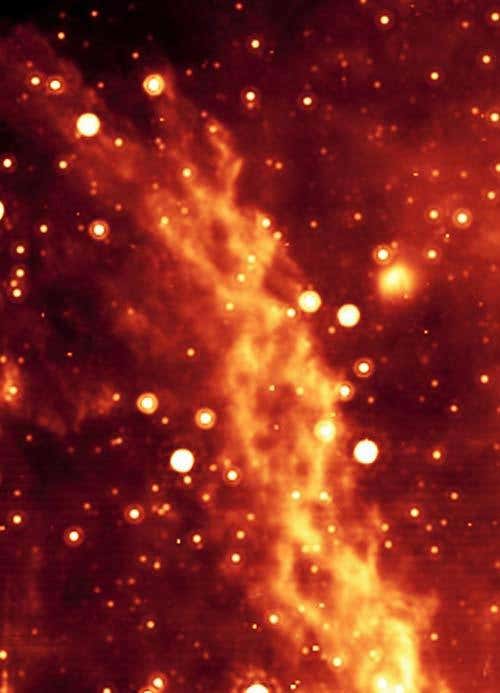
A “double helix nebula” near the Milky Way’s centre has been revealed by the Spitzer Space Telescope’s infrared vision.
“The organising feature is a magnetic field oriented along the long axis of the helix. What has happened is something has twisted that helix.” says Mark Morris of the University of California Los Angeles, lead author of a new study describing the feature.
Morris and his colleagues say the cause of the twist may be a huge disc of gas, known as the circumnuclear disc, which orbits just a few light years outside the black hole at our galaxy’s centre.
Advertisement
Morris told New Scientist the magnetic lines should be anchored in the circumnuclear disc. Then, as the disc rotates, the lines twist around each other and produce a magnetic wave that propagates away from the base.
The portion of the double-stranded, twisting structure captured by the Spitzer image is about 80 light years long and about 300 light years from the Milky Way’s centre. The circumnuclear disc is thought to orbit once every 10,000 years or so. And Morris says that would precisely explain the twists Spitzer has seen in the double helix nebula.
But how can Spitzer see a magnetic structure at all? Morris says the fast moving magnetic wave can carry small dust particles up from the disc and trap them, providing something that can absorb and emit infrared radiation.
“Nobody ever went out to look for these kinds of waves because no one ever really imagined that they’d be visible,” Morris says. “But in this case, it looks like the magnetic field has obliged us.”
Journal Reference: Nature (vol 440, p 308)