NASA’s Space Technology 5 satellites were launched into Earth-orbit by a Pegasus rocket that was carried into the sky by a L-1011 carrier jet (Image: NASA) The micro-sats will travel in a “string of pearls” constellation, demonstrating the ability to position micro-sats to perform simultaneous multi-point measurements (Image: NASA)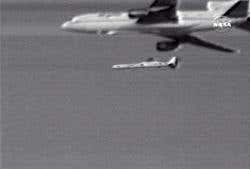
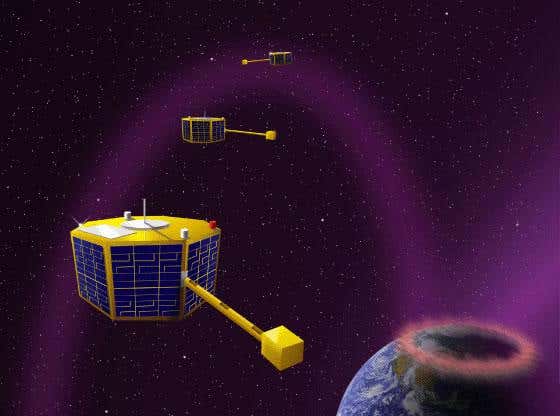
NASA’s newest trio of Earth-orbiting micro-satellites successfully deployed from their Pegasus rocket on Wednesday after previous attempts were aborted first due to bad weather, then for technical reasons. The diminutive trio use their miniaturised scientific instruments to study space weather.
The television-set sized satellites, called Space Technology 5 (ST5), are part of the New Millennium Program which aims to create, develop and test innovative technologies for use in future missions.
Each satellite weighs 25 kilograms and will test the performance of compact instruments. The mission could pave the way for future endeavours involving dozens of such “micro-satellites”, or smaller “nano-satellites”.
Advertisement
Hundreds of satellites
ST5 deputy project manager Candace Carlisle previously told New Scientist “We’re trying to point the way toward missions of tens or hundreds of satellites flying across a wider region of space.”
On Wednesday, an L-1011 carrier jet took off from Vandenberg Air Force Base in California, US, and released a Pegasus XL rocket carrying the ST5 satellites high in the sky at 0603 PST. From there, the rocket boosted into orbit, deployed the first satellite 10 minutes later and released others at three minute intervals.
During their 90-day mission, the ST5 satellites will study the Earth’s inner magnetosphere – the invisible shell that protects the planet from harmful radiation, such as particles that stream away from the Sun in solar flares and coronal mass ejections.


