After 500 million years, the simulation shows the hot bubbles blowing out into space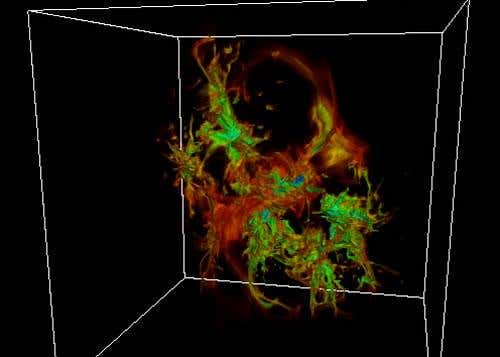
Elliptical galaxies can form from relatively small clumps of gas and stars without requiring cosmic collisions, according to a new computer simulation. Of course, they need a couple of billion years to do so.
Traditionally, elliptical galaxies are thought to form through the collision of smaller spiral galaxies. But in their new simulation, Masao Mori of Senshu University in Kawasaki, and Masayuki Umemura of the University of Tsukuba, both in Japan, show how an elliptical galaxy can form through a repeated sequence of star formation, supernovae explosions and radiative cooling.
The model incorporates the dynamics and resulting chemical and thermal distributions expected in the simulated galaxy, which is about 437,000 light years across and starts out with about 5 billion solar masses of raw material.
Advertisement
A video of the simulation shows the evolution of the galaxy’s density, with red indicating lower density and blue higher density.
Distant clouds
The researchers compared the simulation at various stages of the virtual galaxy’s evolution with real astronomical observations. This suggests that distant clouds called Lyman alpha emitters – which are thought to absorb the ultraviolet light emitted by stars within them – eventually evolve into Lyman break galaxies . Astronomers also see these at extreme distances.
In the simulation, the supernovae of massive early stars form hot expanding bubbles. Then, after 300 million virtual years, the supernova-driven bubbles collide and form “super-bubbles”.
The team thinks that Lyman alpha emitters “could correspond to the early supernova-dominated phase” before the galaxy is 300 million years old. After 500 million years, the simulation shows the hot bubbles blowing out into space. And by 1 billion years, the resulting galaxy has many of the properties, including the metal content, of a Lyman break galaxy.
Journal reference: Nature (vol 440, p 644)