Computer-generated projection of a possible impact trajectory for SMART-1. The final trajectory has yet to be confirmed (Image: ESA)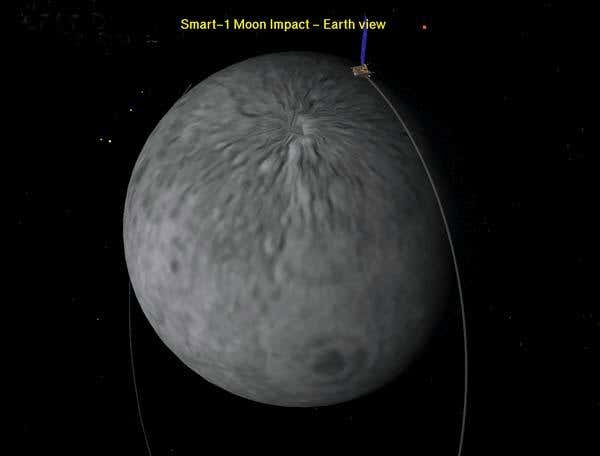
A European probe is boosting its orbit above the Moon in an attempt to postpone crashing into the lunar surface by a couple of weeks. The extra time in orbit means the probe will smash into the near side of the Moon, allowing scientists to study the impact from Earth.
The European Space Agency’s SMART-1 spacecraft has been observing the lunar surface for 16 months and was in an orbit that meant it would crash into the far side of the Moon on 17 August. That would prevent astronomers from observing its demise from Earth.
So on 19 June, mission managers began a 17-day series of manoeuvres to raise its orbit by 90 kilometres, allowing it to stay aloft until it can crash into the near side of the Moon on 3 September.
Advertisement
“The shift in date, time and location for Moon intersection is optimised to favour scientific observations from Earth,” says mission manager Gerhard Schwehm. “Projections based on the current orbit indicated that the spacecraft, if left as is, would impact the Moon on the far side, away from ground contact and visibility. The new location is on the Moon’s near-side, at mid-southern latitudes.”
To reach the Moon from Earth, SMART-1 used solar energy to ionise a small amount of xenon gas. These ions were then vented to space to provide energy-efficient propulsion for the journey, which lasted 14 months.
But all of the xenon gas has been used up. So the current manoeuvres rely on periodically braking a set of spinning reaction wheels, which serve to stabilise the spacecraft. In conjunction with this braking, mission managers will fire thrusters that are normally used to control the spacecraft’s orientation.
By strategically firing the thrusters while SMART-1 is at its farthest point from the Moon, the spacecraft’s velocity will change slightly in the direction of its flight. “This will change the orbit by a cumulative effect,” says spacecraft operations manager Octavio Camino.
SMART-1 will resume its observations of the Moon after the orbital correction. Then two more manoeuvres – one in July and one in September – will be carried out to fine-tune the impact time and location, say mission managers.