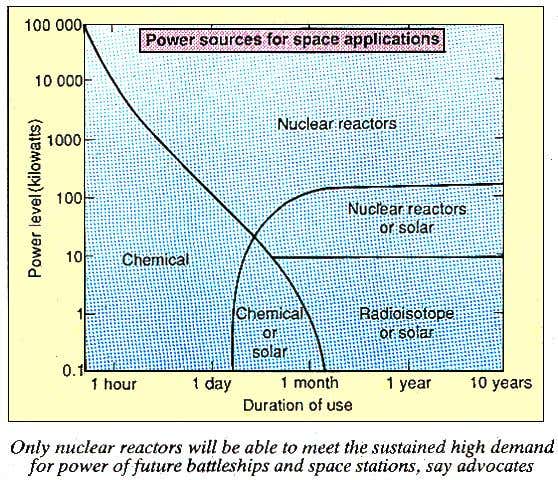
ON THE GROUND, we take toasters and hair dryers for granted, even though they need a thousand watts or more of electricity. There are no such luxuries on spacecraft because power must be generated on board, and there are limits to the size of the power system and the amount of fuel the craft can carry. The heavier the load, the more it costs to launch it. Today’s satellites are frugal with power, which is usually supplied by arrays of solar cells. A typical communications satellite needs between 1 and 1.5 kilowatts of electricity, and the space shuttle manages on 12.5 kilowatts.
These demands are modest, thanks largely to advances in microelectronics, which require very little power. But the space missions of the future will require much more power, and new technologies to supply it.
Lack of power could be a fatal flaw in the US’s plans for the Strategic Defense Initiative. In January, a panel at the National Academy of Sciences called space power systems ‘a pacing item for the successful development of the SDI’. The panel said: ‘Either major innovations in power systems and power system components will be required or SDI power requirements will have to be relaxed.’
Hardware for the SDI is the most power-hungry equipment on the drawing boards. Planners have divided the power needed into three broad levels. The lowest level is a steady output of up to several hundred kilowatts during the 10-year lifetime of a satellite. That power would drive sensors, laser and microwave radars, communications systems and monitoring equipment.
Higher levels of power – in the megwatt range – would be…