IN 20 MARCH 1980 at 1548 hours a needle jumped on a seismograph at the University of Washington in Seattle. The machine had detected the first in a series of moderate-sized earthquakes that heralded the awakening of Mount St Helens after nearly a century of slumber. More quakes followed in quick succession. Three days later, instruments at dozens of monitoring stations were recording as many as 40 quakes an hour.
The mountain rumbled, growled, and shivered. On 27 March a plume of ash and steam spewed 6 kilometres into the air. This tentative eruption turned the mountain’s snow-capped peak a sooty black. Now, dirty and cracked, the mountain continued to flex its muscles. Soon a huge, prophetic bulge began to grow on its north slope.
Finally, on 18 May, Mount St Helens obliged the hundreds of reporters, tourists, and scientists who had gathered for the ‘volcano watch’. At 0832 hours, an earthquake measuring 5.1 on the Richter scale shook the mountain, dislodged its misshapen north face, and triggered an explosive blast 500 times as great as that which destroyed Hiroshima.
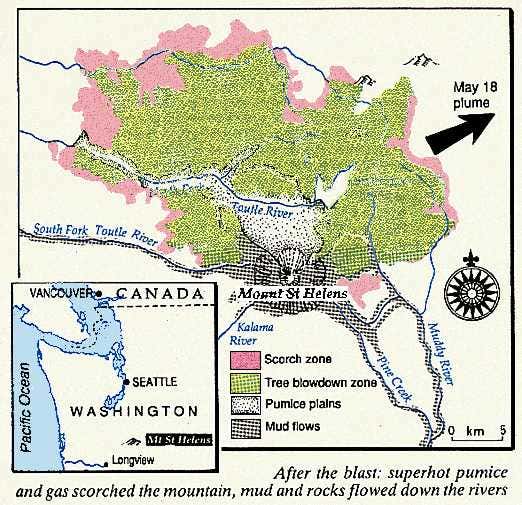
Within seconds, the blast blew down, shredded, or scorched 500 square kilometres of forest. A plume of ash, cinder and pulverised rock rose some 25 kilometres into the sky, turning day into night. When the blowing material fell to Earth, it left deposits of coarse ash, or tephra, more than a metre thick near the volcano. Hundreds of kilometres to the northeast, traces of tephra smudged the ground.
Minutes after the eruption, fragments of pumice and gas, heated to 600 Degree C, poured from the ruptured dome and scoured the…