WHEN Explorer I, the first American satellite, was launched in 1958, it carried a Geiger counter to study cosmic rays. To the amazement of scientists on Earth, at certain parts of Explorer’s orbit, the counter gave a read-out of zero, instead of the 30 counts per second that they were expecting.
James Van Allen of the University of Iowa had designed the experiment. Van Allen and his team knew that the Geiger counter was working because at other points in Explorer’s orbit, the counter behaved as expected. Later, Explorer III recorded enough data to unravel the mystery. It turned out that at certain parts of Explorer I’s orbit, radiation so swamped the counter that there was no time for it to recover from recording one impact before the next struck. As a result, the counter gave a reading of zero. Scientists were so surprised that Ernie Ray, a member of Van Allen’s team, exclaimed: ‘My God, space is radioactive!’
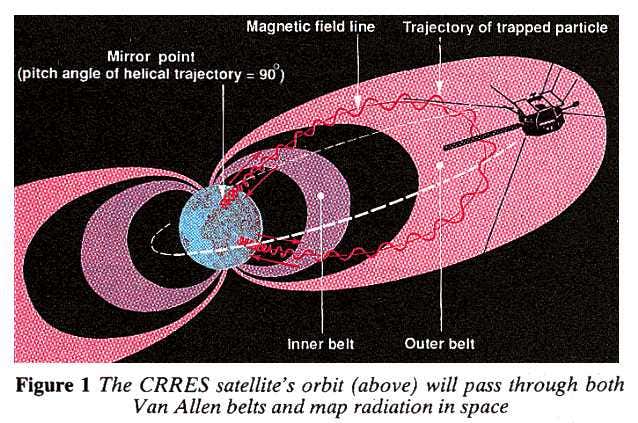
The high intensity radiation proved to exist in belts around the Earth, which were dubbed the Van Allen belts. Since then scientists have learned more about radiation in space, but much remains to be clarified. To find out more, the Pentagon and NASA were due to launch a satellite earlier this week called the combined release and radiation effects satellite (CRRES). It was launched on an Atlas Centaur rocket, and is designed to operate for three years.
By radiation in space, scientists and engineers usually mean charged particles of varying energy levels. The particles might be anything from protons and electrons to iron ions. Clearly, spacecraft manufacturers must design their…