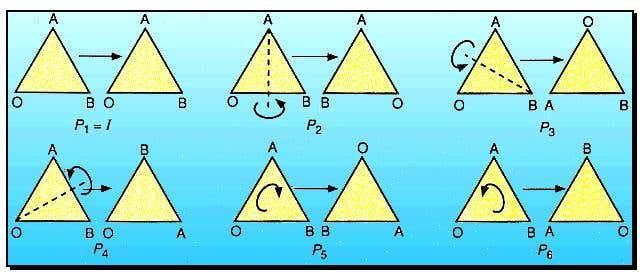
Join in a simple game. Every participant wins a prize, the prize being a glimpse of one of the most fruitful and fundamental branches of mathematics. Line up three pieces of fruit on a table; an apple, an orange and a banana will do. You are now ready to begin.
There are just six arrangements of three pieces of fruit in three positions. Mathematicians describe the change from one arrangement to another as a permutation, thereby using the word in a more active sense than normal. A permutation is what mathematicians call an operation. Swapping the apple and orange is an example of a permutation that gives a new arrangement. Permutations thought of as operations may be combined, for example by swapping the apple and orange, then the apple and banana. By moving around the fruit you can demonstrate four special properties of permutations.
First, no matter how many permutations you apply or in which order you apply them, you will always finish up with an arrangement that could have been reached by applying just a single permutation. Mathematicians describe this property of permutations as closure. Secondly, although the result of two successive permutations usually depends on the order in which they are performed. The rule is called associativity and is common in algebra; it means that a sequence of three operations gives the same result no matter how the operations are grouped together. This second property is a little technical and of limited impact on the uninitiated.
The third property is trivial: there is one permutation that is special because it involves doing nothing; the arrangement produced by the…