Eggs: fragile. The words follow almost automatically. The features which make the eggshell a suitable container for a developing chick embryo are not necessarily those that make the shell suitable for the eggs in your supermarket basket. Every year, egg producers count the cost of the millions of eggs with shells damaged or broken before they reach the consumer – between 6 and 8 per cent of all eggs laid. Worldwide, this damage costs the producers more than $600 million.
Engineers and biologists have devoted many years to the fundamental problem that you do not have to hit an egg very hard before it breaks. They have tried to reduce the impact on eggs from the moment they are laid until they reach the super-market shelves. They redesigned cage floors to reduce the impact on eggs as they are laid, and chicken farms collect eggs more frequently to minimise collisions on rollaways. Despite these efforts, cracked and broken eggs remain a serious problem for the poultry industry. We need stronger eggshells.
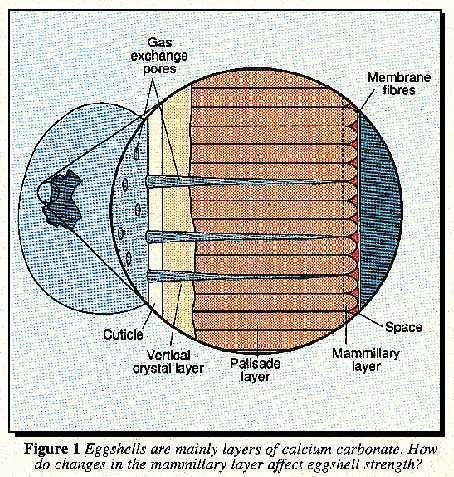
Immediately, this raises two important questions. First, do we know what determines the quality and strength of an eggshell? And if not, how can we find out? During the past 20 years, biologists have successfully exploited the scanning electron microscope to study in detail the structure of the eggshell. They now know that it is made up of several layers. From the inner to the outer surface these are: inner and outer shell membranes, the mammillary layer, the cone layer, the palisade layer, the vertical crystal layer and the cuticle. The shell is formed mainly in the hen’s shell gland…