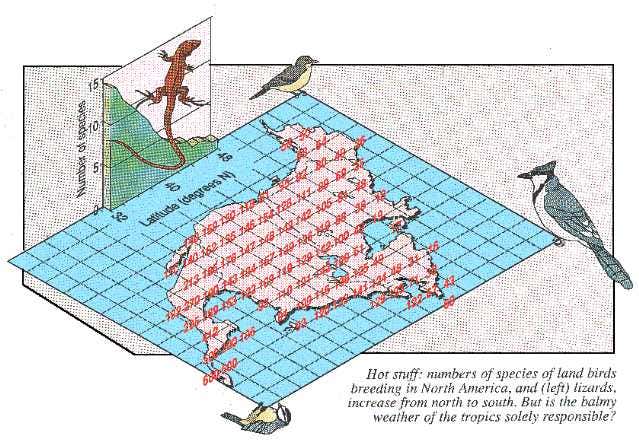
We are surrounded by barren planets. Our own, in contrast, is strikingly alive. No one knows how many different life forms exist, but there are certainly millions. Recent estimates range from a conservative 2 or 3 million to a more extravagant 20 or 30 million. But wherever the true figure lies, we know enough species to begin to look at patterns in where they live in the biosphere.
One pattern among the million-plus recognised species stares us in the face – the number of species increases from pole to equator. The latitudinal gradient in the richness or diversity of species is both dramatic and all-pervasive, showing a truly bulging biosphere. Numbers of species may span two or three orders of magnitude and the changes affect all major taxonomic groups in virtually all habitats. Few tree species grow in the vast natural forests of Canada, Scandinavia and Siberia, while the rainforests of Amazonia, Borneo and the Congo are populated with thousands. Along the north coast of Alaska and Canada, about 20 species of land birds breed in any particular area, compared to around 600 in a region of similar size towards the south of the narrow isthmus of Central America. And the pattern is not confined to land. A study of a group of marine crustaceans revealed a gradual rise from 10 species in the Arctic Ocean to nearly 100 in the tropical Pacific.
Every pattern has its limitations, and this gradient is no exception. Small taxonomic groups such as families and genera may not increase in species richness even though their class or phylum does. The number of bird species may…


