Philologists studying the history and development of languages envy us biologists. They face the problem of exchange of words and grammatical structures between even unrelated languages, and have to sort out the resulting confusion. As genes tend to remain confined to the species in which they originate, and their descendants, we don’t have to worry about this sort of thing.
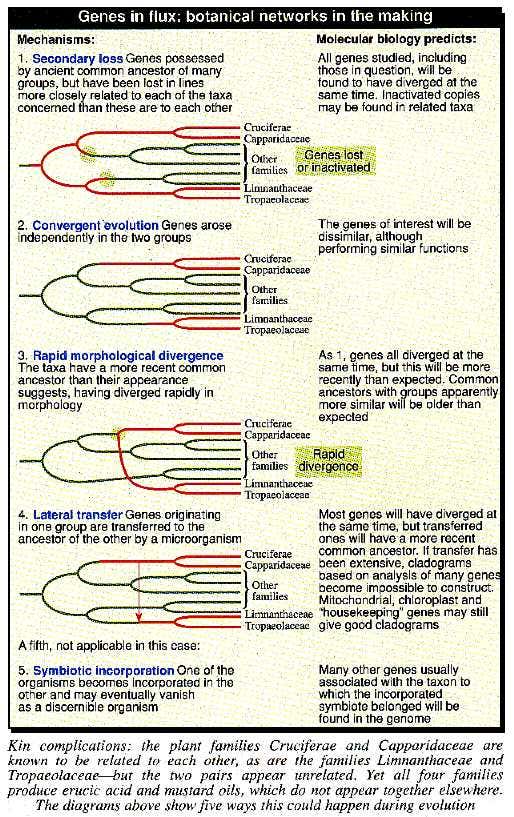
Or do we? Genomes may be less ‘watertight’ than we have supposed. Genetic engineers use bacteria and viruses to transfer genes between very different organisms and the genes frequently function perfectly in their new homes. What we can do in a few years, nature may have done countless times in the past three billion.
Organisms, like languages, remain classifiable, but some groups are more difficult to sort than others. For example, in the past 10 years four highly respected plant taxonomists, Arthur Cronquist, Armen Takhtajan, Robert Thorne and Rolf Dahlgren, have each drawn up systems for the Angiosperms, the flowering plants. They largely agree over the major families, but there is much squabbling over which families belong to which higher-level taxa, such as orders and superorders.
Ever since scientists accepted the theory of evolution, most taxonomy has attempted to reflect phylogeny, the pattern of descent of organisms. We have assumed that genomes change only internally – by mutation and the transposition and duplication of genes, for example – with minimal input from outside. If this is so, we can construct a ‘one true tree of life’. We place on adjacent ‘twigs’ organisms that share a recent common ancestor, such as chimps and ourselves. On remote ‘branches’ we place those such…