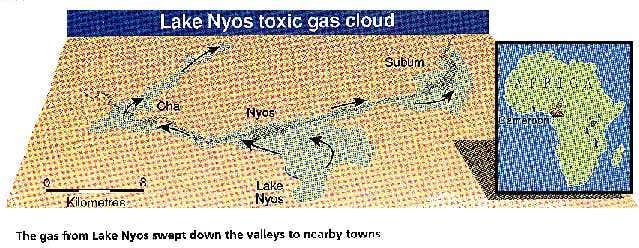
Late on the evening of Thursday 21 August 1986, a deadly cloud of gas
swept along the valleys north of Lake Nyos in western Cameroon, leaving
a trail of death and devastation in its wake. News started to circulate
the following day and on the Saturday when people from outside the immediate
area visited the market village of Nyos. On Sunday, two scientists from
Cameroon’s Ministry of Mines and Power visited Lake Nyos. By then news of
the disaster was spreading around the world, with eerie descriptions of
villages where every living thing had died – men, women, children, cows,
chickens and even insects. The death toll of more than 1700 people brought
a rapid response from many governments, in the form of aid as well as teams
of scientists to help to find out what had caused so many deaths.
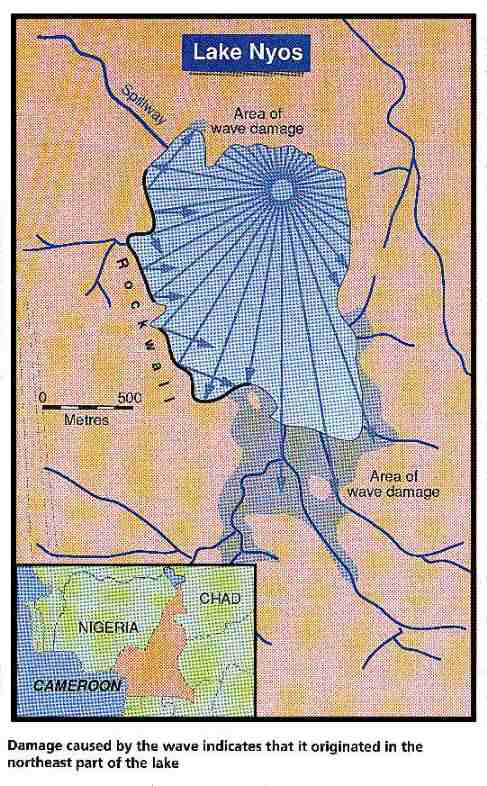
The victims had been overwhelmed by a cloud of poisonous gas from Lake
Nyos. Because the lake lies in a volcanic crater, many of the first investigators
on the scene assumed that this dormant volcano had come back to life and
released a cloud of hot toxic gas beneath the lake. Other investigators
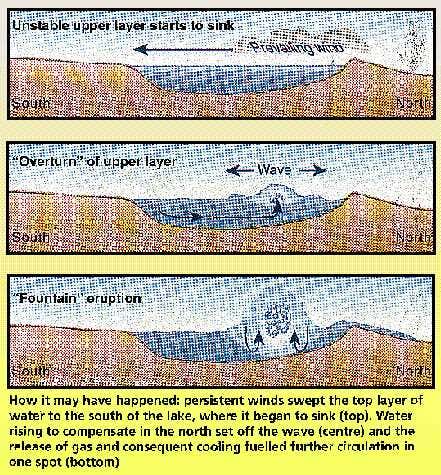
soon realised that the evidence pointed to the slow build-up of carbon dioxide
deep in the lake, followed by its release as a cold, suffocating aerosol.
Initially, the assumption that volcanic gases were responsible hampered
the investigations. But it also proved a bonus. In any natural disaster
it is vital to collect reliable information quickly and volcanologists tend
to react fastest and are most willing to go to potentially hazardous areas.
A team of Italian volcanologists…