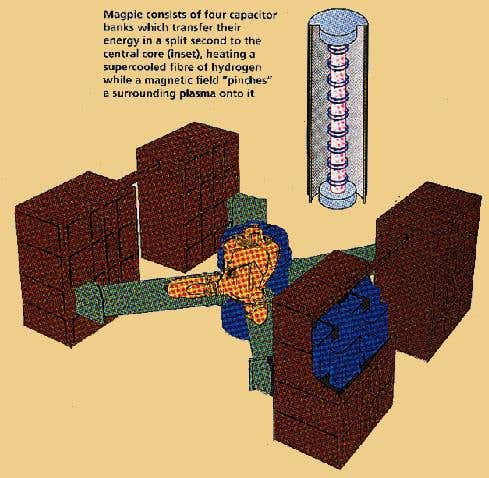
One of the most formidable generators of electrical power is gradually taking shape in a basement laboratory in the heart of London’s West End. Drawing less energy from the national grid than a domestic kettle, the generator should soon be able to produce a pulse of power about 30 times larger than all of Britain’s power stations put together.
Scientists want to use this high-voltage tool to force an enormous current through a fine strand of frozen hydrogen. Their aim is to gain a better understanding of thermonuclear reactions and, ultimately, how controlled nuclear fusion, which has proved remarkably elusive so far, could provide an alternative source of electrical energy. For this, they would replace the hydrogen with its isotopes, deuterium and tritium – fusion’s fuel.
The device, known as a pulsed-power generator, will be the largest of its kind in the civilian world, smaller only than half-a-dozen or so similar devices in military laboratories in the US, Russia and Europe. Known as Magpie (Mega Ampere Generator for Plasma Implosion Experiments) and being built by the plasma physics group at Imperial College, it is a tangible break from the traditional approaches to fusion research.
Magpie will not be ready for use until June, but so keen are its developers to get on with their investigations that they are buying time on Russia’s largest generator, the Angara-5-1, at the Troitsk laboratory of the Kurchatov Institute, once a top-secret military establishment on the outskirts of Moscow. Over the next fortnight, with physicists from France’s National Agency for Scientific Research (CNRS), they will finish a set of experiments started last September in what heralded…