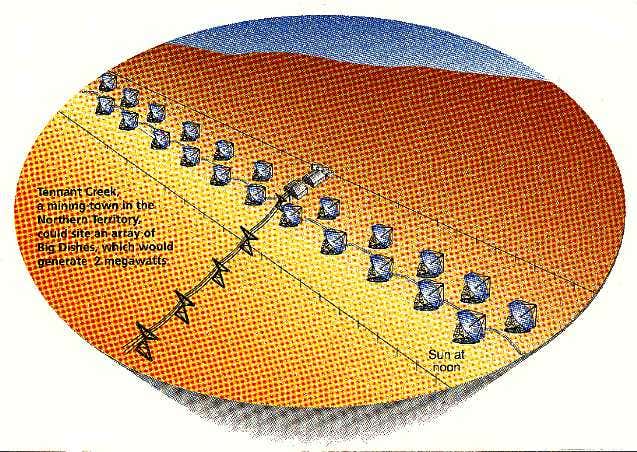
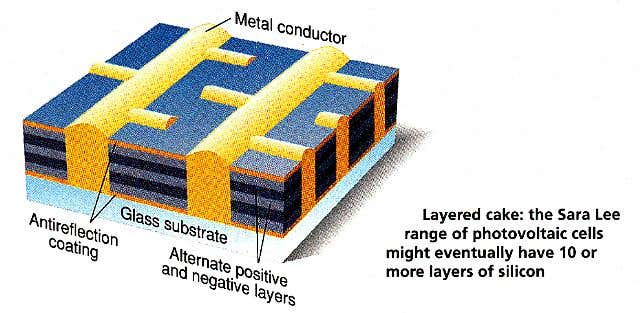
Solar power is expected to receive another boost this week, following a hectic couple of months during which the advocates of different solar technologies have been vying for the limelight – as well as trying to steal a march on their rivals. The drama has been unfolding in Australia where there are three technologies competing for commercial credibility. Two are based on solar thermal systems, which recover heat from the Sun to drive steam turbines. One uses parabolic troughs to focus sunlight onto tubes containing fluid, which heat up and create the steam; the other uses enormous dishes. A third technology relies on photovoltaic cells that use semiconductors to turn sunlight directly into electricity. Though most solar research has focused on photovoltaic cells, the high manufacturing cost of the cells has proved a commercial stumbling block.
Steam challenge
In May, however, the team that holds the record for designing the most efficient photovoltaic cells announced that it had found a way of making the cells more economically viable. Martin Green and his colleagues at the University of New South Wales in Sydney said that they could cut cost of a cell by 80 per cent by using poorer quality silicon. But these cells will need to be developed quickly if they are to keep pace with the advances being claimed for solar thermal systems.
Last month, such a system used an enormous hexagonal dish to turn sunlight into steam efficiently enough to challenge the performance of photovoltaic cells. The Big Dish, which stands on the campus of the Australian National University in Canberra, is the largest of its type in…


