THE trials and tribulations of sorting molecules—big from small, heavy
from light—could soon be a thing of the past. Physicists have developed a
way that is much simpler than the messy methods used today.
One major headache for researchers is sorting bits of DNA. To sequence a
genome, biologists shred DNA and then sort the fragments by putting the broken
molecules in a gel. In an electric field, the molecules start to separate, with
shorter, lighter molecules moving more quickly through the gel than slower,
heavier ones.
But the process has its drawbacks. The sorted fragments can’t easily be
recovered from the gel, and once the separation has started, you can’t add any
more material without messing things up.
Now Deniz Ertas, a physicist at Exxon Research and Engineering at Florham
Park, New Jersey, has come up with a way of defeating both problems. In the 16
February issue of Physical Review Letters, he will describe how a
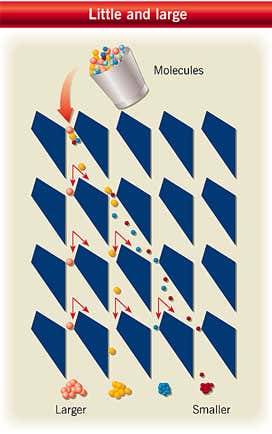
vertical grid of lopsided lozenges, each about 4 micrometres long, could
separate molecules without the need for gels. It would allow constant sorting
and reuse of the processed molecules.
Advertisement
The mixed molecules are dripped in next to a lozenge’s rightmost wall, which
is vertical. All the molecules naturally diffuse away from the wall, but heavy
ones diffuse less rapidly. When the mixture hits the tip of the next lozenge,
heavy molecules are shunted to the left and light ones to the right. The process
repeats all down the grid, and at the bottom, the molecules should be neatly
sorted into bins, based on size.
Though Ertas’s work is entirely theoretical, in the same issue, a team led by
Robert Austin of Princeton University in New Jersey says that it has
independently come up with a similar technique. It has also made a
microlithographic array of obstacles and used it to sort DNA fragments and
colour-coded balls of various sizes. “We can see the balls separating,” says
Austin. “It shows that this is really beyond the stage of theoretical
speculation,” adds Ertas. “It’s really exciting for me.”