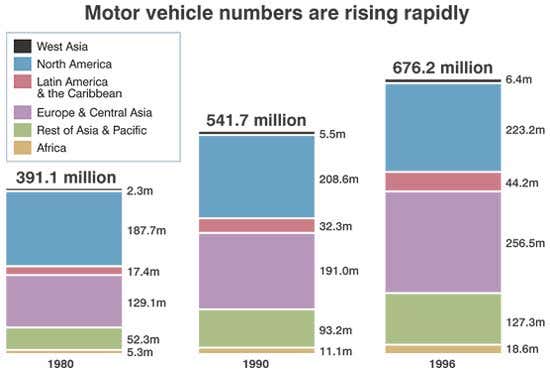
IF CAR numbers keep increasing at the present rate, there will be more than
a billion on the road by 2025. Today, motor vehicles put out 900 million
tonnes of carbon dioxide a year—about 15 per cent of our total output.
More vehicles will mean more global warming.
Also by 2025, two-thirds of the world’s people will live in cities, so traffic
jams and pollution will loom large in most people’s lives. Worst of all will be
the megacities of Asia. Beijing, Shanghai and Calcutta will each be home to as
many as 20 million people, Bombay to 25 million.
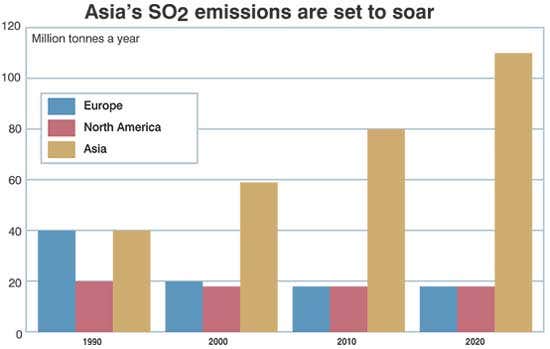
Life in the country may not be much better. Asia is heading for a downpour of
acid rain that will destroy forests and wither crops. The worst hit look like
being Thailand, south-east China, north-east India and Korea, where economic
growth is powered by fossil fuels rich in sulphur.
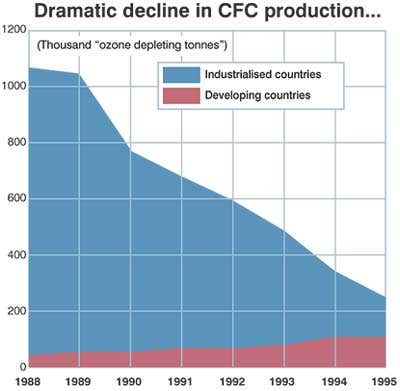
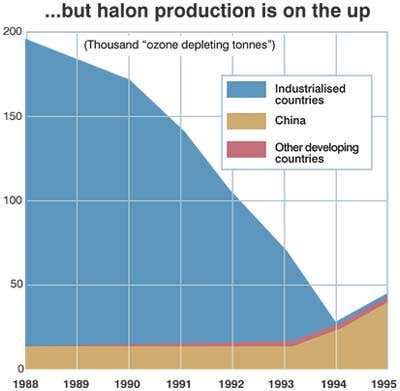
Industrialised nations have reduced SO2 emissions. They have also cut
production of CFCs and Halons, the chemicals that destroy stratospheric ozone.
But the ozone layer is not yet safe. Under the Montreal protocol, developing nations
have until 2010 to cut production. There is still a black market in CFCs, and halon
production has increased in countries such as Brazil, India, Mexico and China.
-
Sources:
Vehicles, UNEP; -
SO2, CFCs and halons,
World Resources Institute