THIS was the year that superconducting went mainstream.
In May, 150,000 Danish homes began receiving power through superconducting
cables installed in a Copenhagen substation. In November, about 30,000 homes in
Detroit followed suit.
These are remarkable engineering achievements because superconductors work
only at extremely low temperatures—usually close to absolute zero. The
Copenhagen and Detroit projects have got around this by using cables that carry
a flow of liquid nitrogen, cooling a ceramic superconducting material to
–196 °C
(see diadram).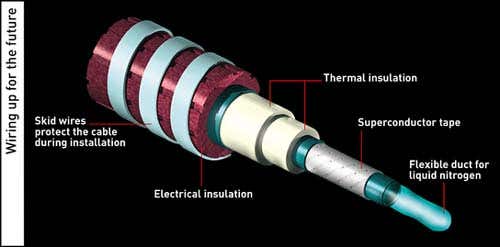
At this temperature the electricity flows with no resistance
and—theoretically, at least—no power loss. So although the cables
cost more to make and run than copper ones, you need fewer of them. With some
further development and the savings provided by mass production, they should
prove a competitive alternative to copper.
In the past, superconductors have been restricted to extremely costly bits of
gadgetry such as magnetic resonance imagers. But if superconducting wires and
cables become affordable, they could be used far more widely. Researchers are
already designing and building superconductors into highly efficient electric
motors and generators, and ultra-fast trains could soon be using powerful
superconducting electromagnets to levitate above the track.
Practical implementations were not the only good news. In January, Jun
Akimitsu and his co-workers at Aoyama-Gakuin University in Tokyo, Japan,
discovered that magnesium diboride becomes superconducting at –235 °C.
The superconducting potential of this material, which is cheap and widely
available, had previously been overlooked but the discovery has prompted a huge
research effort.
Several labs around the world have already produced tens of metres of
magnesium diboride wire. Even though…



