FROM ancient Syracuse, through the medieval Holy Land to Istanbul and, finally, California, it has been a long journey for a musty old prayer book. But what is written on it makes the journey worthwhile. “This is Archimedes’ brain on parchment,” says William Noel, curator of ancient manuscripts at the Walters Art Museum in Baltimore, Maryland. Hidden beneath the lines of ancient prayers and layers of dirt, candle wax and mould lies the oldest written account of the thoughts of the great mathematician.
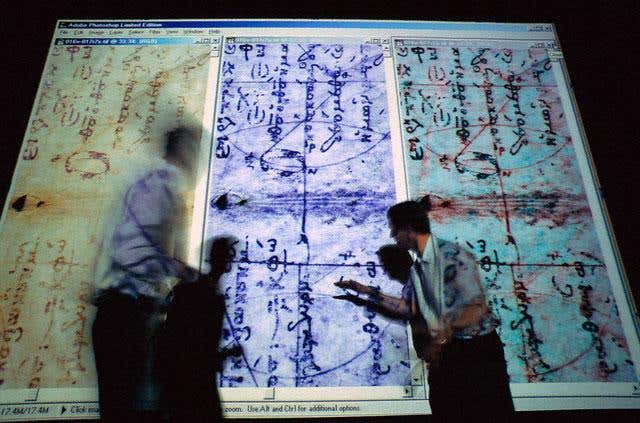
This invaluable artifact is a classic example of a palimpsest: a manuscript in which the original text has been scraped off and overwritten. It was discovered more than a century ago, but only in the past eight years have scholars uncovered its secrets. Using advanced imaging techniques, they have peered behind the 13th-century prayers inscribed on its surface to reveal the text and diagrams making up seven of Archimedes’ treatises. They include the only known copies of The Method of Mechanical Theorems, On Floating Bodies and fragments of The Stomachion in their original Greek.
As the investigation drew to a close in August, the impact of these discoveries became clear. What one of the experts described as “a very drab and dirty object” sheds fresh light on how Archimedes developed proofs and theorems, and shows that he may have employed and understood the concept of infinity more rigorously than previously thought. It also suggests that Archimedes discovered the field of mathematics called combinatorics, an important technique in modern computing. These are remarkable discoveries, yet it is only through a chain of chance events that the text was…