Double arm amputee Christian Kandlbauer shows how realistic prostheses can be (Image: Waltraud Grubitzsch/epa/Corbis)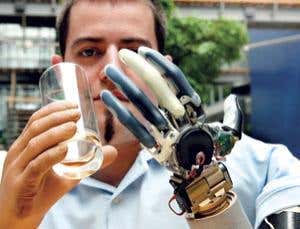
FIVE years after he lost a leg to a landmine in Afghanistan, American war veteran Mike McNaughton can run well enough to coach his 11-year-old son’s soccer team. This amazing comeback comes partly from his determination to get back on two feet, but also from a piece of high-tech hardware: a computerised, hydraulic knee that monitors and adjusts every step, with a response time in milliseconds. “Now I can run with the kids full blast and kick the ball around with them,” he says.
After decades of amputees having to make do with designs that had changed little since the second world war, artificial limbs that predict their user’s every movement and look like the real thing are finally breaking out of the lab. Yet convincing and comfortable synthetic limbs like McNaughton’s are only the beginning of the bionic age.
Emerging prosthetic technologies promise not only greater power and flexibility but also pressure-sensitive artificial skin, and even limbs that are bonded to the body and controlled by the mind – and much of this within five years. Rebuilding amputees to be faster and stronger than before is rapidly becoming a realistic possibility. With experimental prosthetics increasingly able to integrate with flesh, bone and the nervous system, the very idea of “losing a limb” may one day become obsolete.
“This is perhaps the most exciting time ever to be involved in advanced prosthetics,” says John Bigelow of the applied physics laboratory at Johns Hopkins University in Baltimore, Maryland, who works on brain-controlled robotic arms.
There are many reasons…