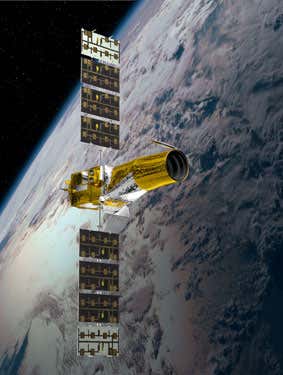
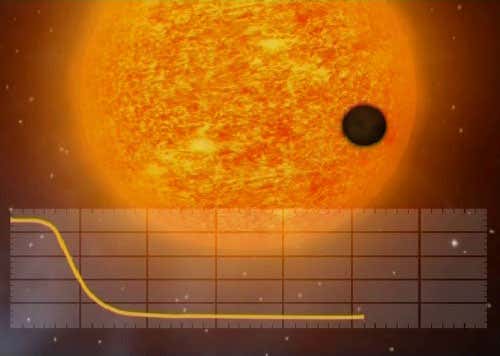
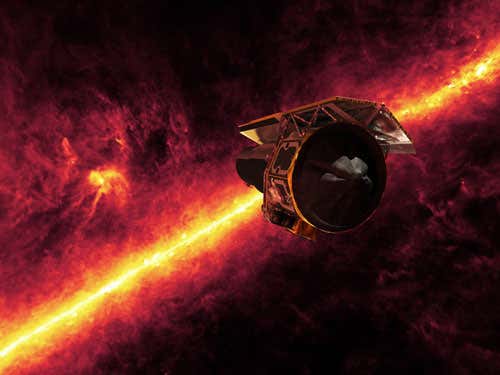
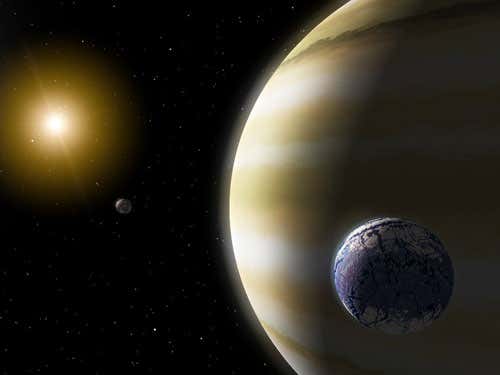
In this artist’s conception, a possible planet spins through a clearing in a nearby star’s dusty, planet-forming disc. This clearing was detected around the star CoKu Tau 4 by NASA’s Spitzer Space Telescope. Astronomers believe that an orbiting massive body, like a planet, may have swept away the star’s disc material, leaving a central hole. The possible planet is theorized to be at least as massive as Jupiter (Image: R Hurt (SSC) / JPL-Caltech / NASA) Artist’s view of COROT, an exoplanet hunter mission led by the French national space agency CNES, with ESA participation. Launched at the end of 2006, COROT is in a circular, polar orbit around Earth that allows for continuous observations of two large and opposite regions in the sky for more than 150 days each (Image: D Ducros / CNES) One of the methods for detecting exoplanets is to look for the drop in brightness they cause when they pass in front of their parent star. This alignment is known as a planetary transit. From Earth, both Mercury and Venus occasionally pass across the front of the Sun. When they do, they look like tiny black dots passing across the bright surface. Such transits block a tiny fraction of the light, which the COROT mission is able to detect (Image: CNES) The Spitzer Space Telescope, seen against the infrared sky. The band of light is the glowing dust emission from the Milky Way. Spitzer looks towards the Rho Ophiuchi star-formation region, which looms just above the disk of the Milky Way (Image: JPL-Caltech / NASA) Artist’s impression of an extrasolar planet with hypothetical (possible but unproven) water-bearing moons…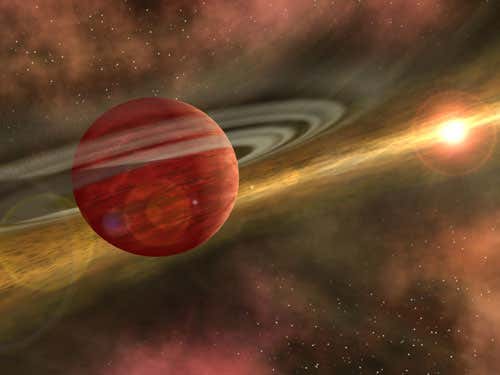
Space
Is the solar system unique?
By David Shiga
28 January 2009


