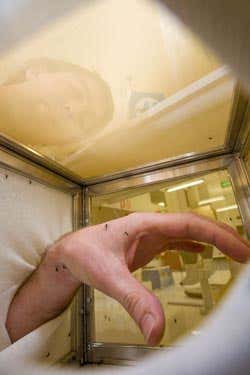
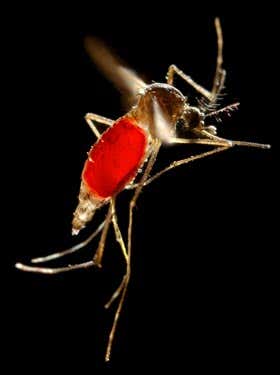
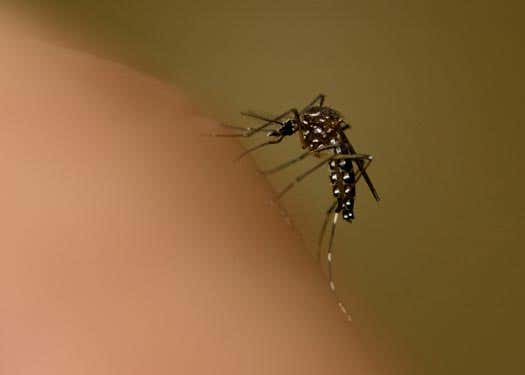
A coloured scanning electron micrograph (SEM) of the head of a female yellow fever mosquito, Aedes aegypti. The head is at centre right, with large compound eyes (blue). There are two hairy antennae and a long proboscis (pink) used for penetrating human skin and sucking blood (Image: Eye Of Science / SPL) Volunteers donating blood to Aedes aegypti mosquitoes at the Tropical Medicine Mosquito Research Facility at James Cook University, Cairns (Image: Scott O’Neill) The Aedes aegypti mosquito in flight. This species is the main vector responsible for the transmission of dengue fever (Image: CDC-Collins /Phanie / Rex Features) An Aedes aegypti mosquito sucking human blood at the Tropical Medicine Mosquito Research Facility at James Cook University, Cairns (Image: Scott O’Neill) Growing problem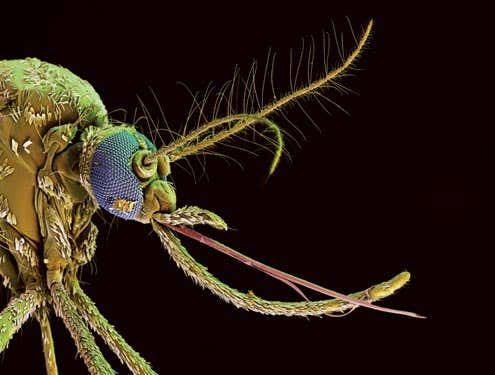
I am standing underneath a house. Like many traditional raised houses here in Queensland, Australia, the space under this one is an extension of the living area, with old furniture, laundry airing in the corner, stubby holders on the coffee table – and mosquitoes. Hundreds of them.
I swat at my bare ankles and arms. At this house, though, guests are not usually allowed to kill mozzies. Quite the opposite, in fact. Here, most visitors come to feed the mosquitoes – fresh blood, 10 minutes a day, every day (see image).
For these are no ordinary mosquitoes, and this is no ordinary house. Instead, it’s a mock-up of the underbelly of an old “Queenslander”, complete with its own backyard mimicking typical conditions under the shade of a mango tree, all enclosed by a mosquito-proof, stainless-steel mesh cage. Welcome to the state-of-the-art Tropical Medicine Mosquito Research Facility…
