Cosmic strings at the dawn of the universe may have fragmented and whipped “beads” across the cosmos (Image: Adolf Schaller for STScI/NASA)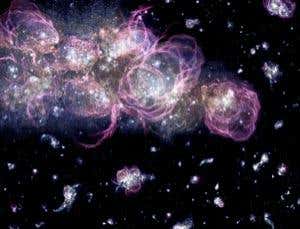
SPACE-TIME should have universe-sized snags called cosmic strings running across it, but none have yet been found. That could be because they broke into a tangle of smaller strings and beads soon after the big bang. The good news is that this would have created gravitational waves that could be detected on Earth.
Many theories predict the existence of cosmic strings. These topological defects in space-time, which can be larger than the observable universe, should have formed as…