Measuring the distance of the moon from Earth is one way of testing Einstein’s theory of relativity (Image: Dan Long)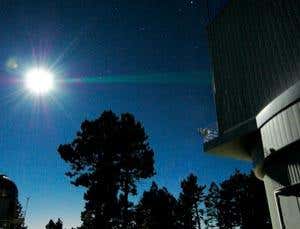
EACH clear night when the moon is high in the sky, a group of astronomers in New Mexico take aim at our celestial neighbour and blast it repeatedly with pulses of light from a powerful laser. They target suitcase-sized reflectors left on the lunar surface by the Apollo 11, 14 and 15 missions, as well as by two Russian landers.
Out of every 300 quadrillion (1015) photons that are sent to the moon, about five find their way back. The rest are lost to our atmosphere, or miss the lunar reflectors altogether.
From this small catch, the team can assess the movement of the moon to an accuracy of a millimetre or two – a measurement so precise that it has the potential to show up any cracks in Einstein’s general theory of relativity. If that’s what it does, this lunar laser-ranging experiment will become Apollo’s greatest scientific legacy.
Lunar laser ranging has a long history. “I wasn’t even born when the first reflectors were left on the moon,” says 39-year-old Tom Murphy from the University of California, San Diego, who heads the experiment at the Apache Point Observatory in Sunspot, New Mexico (pictured).
In the mid-1960s, when NASA asked for suggestions for experiments that could be carried out on the moon, laser ranging was mooted but no one really knew what to do with it. There was a suggestion to look for gradual changes in Newton’s gravitational constant, but this would have meant running the experiment for over…