Tetrahedra pack tightly, even when jumbled together (Image: A. Jaoshvili/P. Chaikin/M. Porrati/A. Esakia)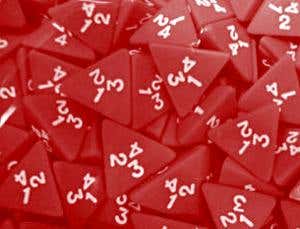
If physicists ran candy stores, gumball machines might be filled with pyramids instead of spheres. It seems that tetrahedra, with their four triangular faces, are the most efficient shape for filling a container randomly, as opposed to carefully stacking objects within it.
Graduate student Alexander Jaoshvili of New York University and his colleagues filled and shook containers of tetrahedral game dice. They found that the tetrahedra were packed tightly enough to occupy 76 per cent of their containers. In comparison, randomly packed spheres fill up to 64…


