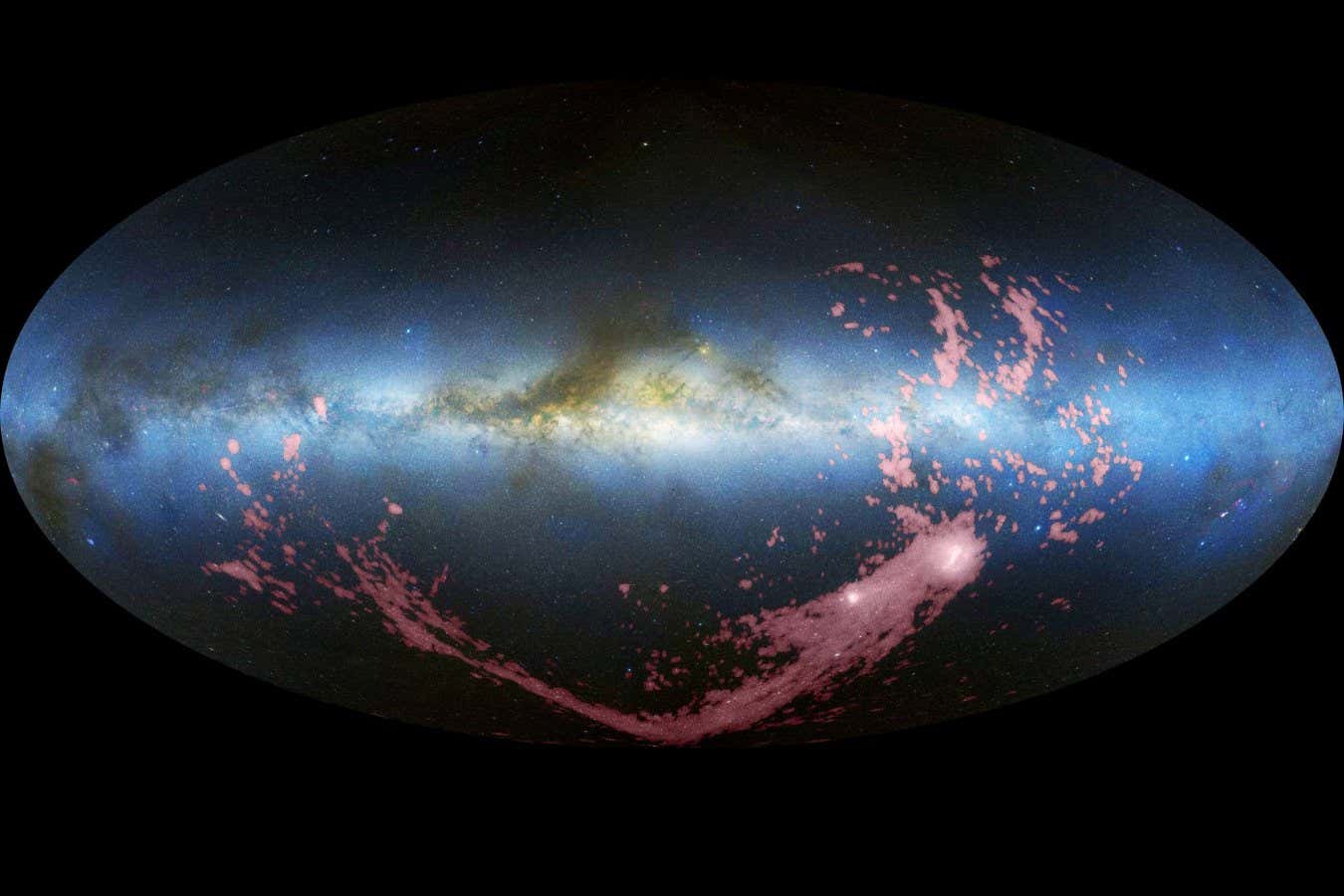
Shining zombies (Image: Y. Beletsky/ESO)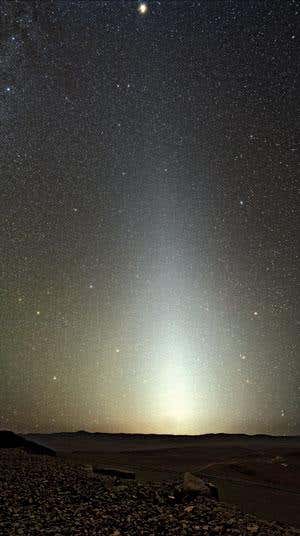
TRAVEL out into the primal darkness, far away from the bright lights of civilisation, and, on a clear night in the hour before dawn, you may see a great pyramid of light rising up into the sky from the eastern horizon.
Back in the 11th century, the Persian poet and astronomer Omar Khayyam alluded to this “false dawn” in his Rubaiyat. Known as zodiacal light because it follows the same broad band of the sky as the constellations of the zodiac, the phenomenon is caused by sunlight reflected off dust in space. This explanation goes back to a suggestion made by the English astrologer and archdeacon Joshua Childrey in 1661. But till now, where that dust comes from, and how it stays there, has had us stumped.
The zodiacal dust forms a vast, diffuse cloud that extends all the way from the sun to beyond the orbit of Mars (see diagram). It is densest in the orbital plane of the Earth and the other inner planets, but as the Infrared Astronomical Satellite (IRAS) telescope revealed in the 1980s, it is also fluffed up for tens of millions of kilometres on either side.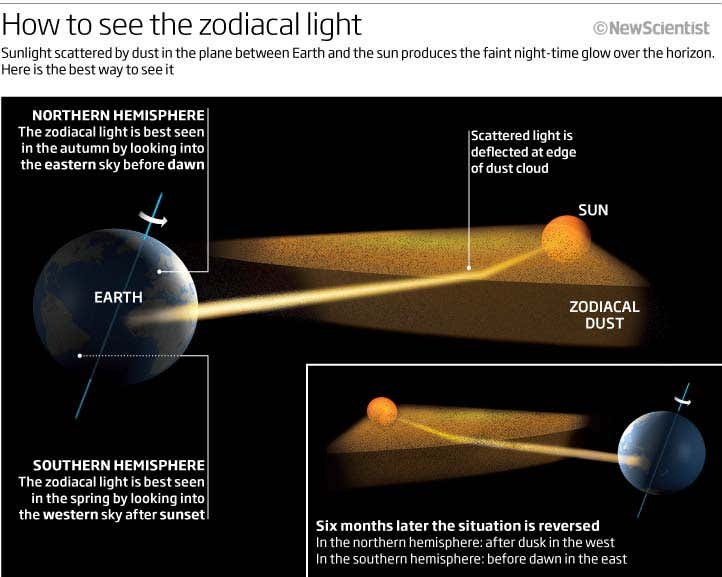
This dust can’t just be stuff left over from the creation of the solar system. Dust grains would orbit the sun indefinitely like minuscule planets, were it not for a peculiar force called Poynting-Robertson drag. As a dust grain zooms along, it ploughs through the stream of sunlight that pervades the solar system. This slight photon headwind gradually robs the grain of its angular momentum, making it spiral slowly inwards.…