The group of galaxies known as the Bullet cluster provides good evidence for dark matter (Image: NASA/CXC/CfA/M.Markevitch et al/STScI/Magellan/U.Arizona/D.Clowe et al/ESO WFI)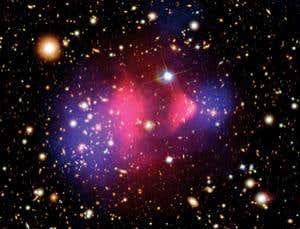
The expanding universe predicted by general relativity has become firmly entrenched in modern science. As our ability to observe distant galaxies and map out the cosmos has improved, our picture of the universe has revealed some even more exotic features.
For a start, astronomers have been able to measure how fast distant spiral galaxies spin, and this shows that the outskirts of galaxies are rotating far too quickly to be reined in by the mass of the stars and gas at their centres. More matter is needed in galaxies to generate enough gravity to prevent galaxies from flying apart.
The popular explanation is that galaxies contain large quantities of other forms of matter – known as “dark matter” because it does not emit or reflect light. Dark matter is thought to clump around galaxies and clusters of galaxies in gigantic balls known as halos. Dark matter halos can be dense enough to significantly distort space-time and bend the path of any light rays that pass close by. This gravitational lensing has been observed in a number of clusters of galaxies, and is one of the strongest pieces of evidence for the existence of dark matter.
But that’s not all. Cosmologists have been able to figure out how fast the universe expanded at different times in its history. This is done by measuring the distance to exploding stars called supernovae, and how quickly they are receding due to the expansion of space-time. The ground-breaking results from these observations, which emerged just over a decade ago, is…