Collisions between frozen particles creates charge, this builds until it discharges as lightning (Image: Barcroft Media/Getty)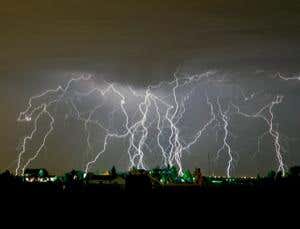
Read more: Instant Expert: Extreme weather
Tornadoes reveal the atmosphere at its most violent. Spawned by thunderstorms, they produce the fastest winds of any natural phenomenon. It is fortunate for us that most tornadoes are small, and that the seriously destructive ones are extremely rare
Tornadoes
During a tornado in Bridge Creek, Oklahoma, on 3 May 1999, Doppler radar revealed a wind speed of 486 kilometres per hour about 30 metres above the ground – the fastest ever recorded. Winds of this strength cause total destruction, sweeping strong timber-frame houses off their foundations and badly damaging steel-reinforced concrete structures.
Fortunately, in the past decade there have only been three top-end tornadoes earning an EF-5 designation on the Enhanced Fujita scale (winds exceeding 322 kilometres per hour). Unlike hurricanes, tornadoes are quite small, ranging from 75 metres across to about 3 kilometres. They descend from cumulonimbus (thunderstorm) clouds, which can be over land or water. Those that form or move over water are called waterspouts and tend to be much weaker than tornadoes over land.
A very particular set of conditions is needed for tornadoes to form. Most important is the presence of instability and wind shear. A low-altitude flow of warm, moist air from an ocean area combined with a flow of cold, dry polar air high up creates maximum instability, which means that parcels of air heated near the surface rise rapidly, creating powerful updrafts.
If a strong jet stream is present, with high winds near the top of the troposphere, there will…