(Image: Evgeny Karandaev/Shutterstock/Getty)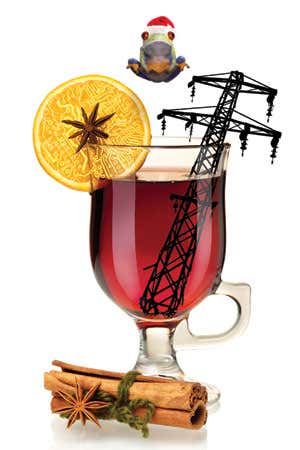
Can’t get your new material to lose all electrical resistance? Try mulling it in red wine
WONDERING what to do with any booze left over from your Christmas party? Most people would be happy to pour the dregs down the sink and keep the untouched stuff for later. But Yoshihiko Takano has another idea: donate it to the search for superconductivity.
Takano, a physicist at Japan’s National Institute for Materials Science in Tsukuba, discovered a few months ago that alcoholic drinks can transform fairly ordinary materials into amazing ones. Unlikely as it sounds, booze could help to unlock one of the biggest mysteries in physics: superconductivity.
Superconductors are revered because they conduct electricity with zero resistance. That makes them fascinating from a theoretical viewpoint, and also points to brilliant applications. If you could make overhead power lines from superconducting cables they would lose barely any of the electrical energy they carry, saving money and cutting carbon dioxide emissions. Superconductors also repel magnetic fields, which means they can levitate anything containing materials with the merest hint of magnetism – including trains.
With such remarkable properties, you might expect to find superconductors in use everywhere. The reason you don’t is that they need to be extremely cold to work properly. Most only superconduct at temperatures close to absolute zero. This has been a source of frustration ever since superconductors were discovered, in 1911, when Dutch physicist Heike Kamerlingh Onnes found that he could make mercury lose all electrical resistance by chilling it to 4.2 kelvin (-269 °C) in liquid helium. Many more metallic superconductors have since been discovered, but none…