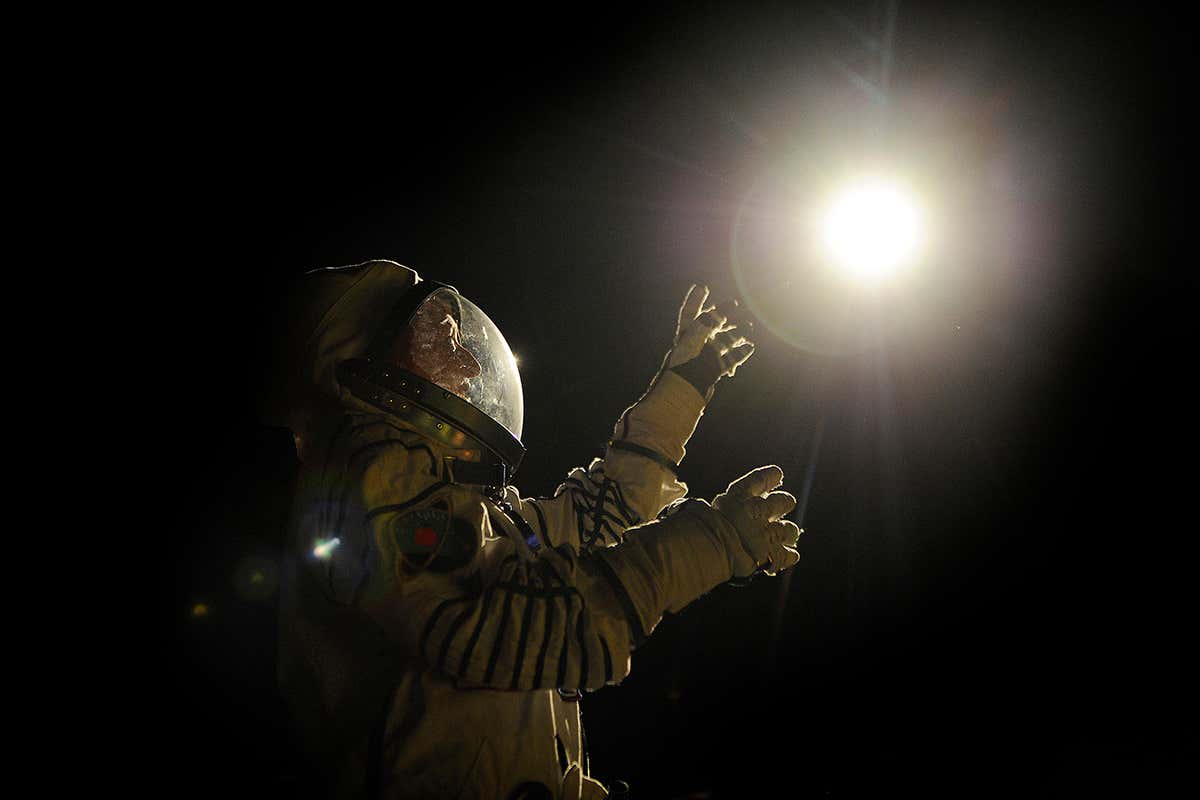
What are the chances of being alone? (Image: SPL)
Read more: “Existence special: Cosmic mysteries, human questions“
HAVE you ever looked up at the night sky and wondered if somebody, or something, is looking back? If perhaps somewhere out there, the mysterious spark we call life has flickered into existence?
Intuitively, it feels as if we can’t be alone. For every one of the 2000 stars you can see with your naked eye, there are another 50 million in our galaxy, which is one of 100 billion galaxies. In other words, the star we orbit is just one of 10,000 billion billion in the cosmos. Surely there is another blue dot out there – a home to intelligent life like us? The simple fact is, we don’t know.
One way to estimate the number of intelligent civilisations was devised by astronomer Frank Drake. His equation takes into account the rate of star formation, the fraction of those stars with planets and the likelihood that life, intelligent life, and intelligent creatures capable of communicating with us, will arise.
It is now possible to put numbers on some of those factors. We know that about 20 stars are born in the Milky Way every year and we have spotted more than 560 planets around stars other than the sun. About a quarter of stars harbour a planet similar in mass to Earth (Science, vol 330, p 653).
But estimating the biological factors is little more than guesswork. We know that life is incredibly adaptable once it emerges, but not how good it is at getting started in the first place.…