Subscribe now

Life

What insect societies tell us about cells

Could the destiny of social insects and human cells be controlled by the same mechanisms?

By Seirian Sumner and Solenn Patalano

23 May 2012

New Scientist. Science news and long reads from expert journalists, covering developments in science, technology, health and the environment on the website and the magazine.

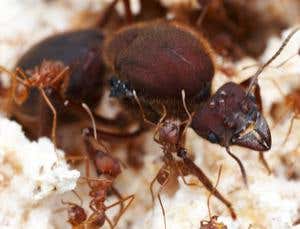
Queen Atta texana ants dwarf workers, almost as if they are different species

(Image: Alex Wild)
THEY fight, punish, reward and coerce their friends. They are promiscuous, selfish, altruistic, deceptive and manipulative. They are farmers, predators and scavengers. They dispense law and order. Eusocial insects – bees, wasps, ants and termites – are the soap opera stars of the non-human animal kingdom.

Much of that behaviour centres around an extreme division of labour, with individuals becoming queens, workers and sometimes soldiers. Once it starts, this process is usually irreversible – much as embryonic stem cells have no alternative but to become part…
Sign up to our weekly newsletter

Receive a weekly dose of discovery in your inbox. We'll also keep you up to date with New Scientist events and special offers.

Sign up

To continue reading, subscribe today with our introductory offers

Popular articles

Trending New Scientist articles

Piano Exit Overlay Banner Mobile Piano Exit Overlay Banner Desktop