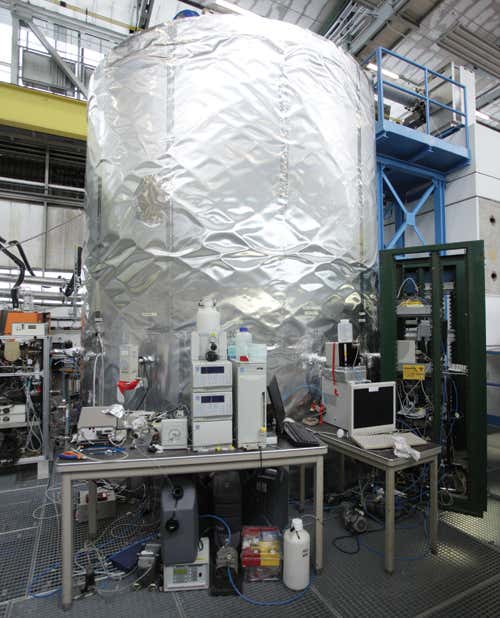
How many cosmic rays have you soaked up? (Image: Sisse Brimberg/National Geographic) Cloud in a bottle (Image: Dave Stock)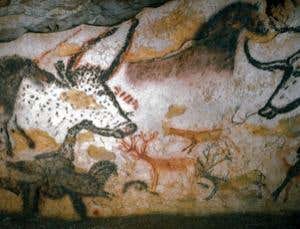
Particles from outer space have taught us about the inner workings of the subatomic world and promise to solve other puzzles on a cosmic scale. Closer to home, however, we have learned to harness cosmic rays in ingenious ways. They are helping us to unravel secrets of our past. Yet, ultimately, they may limit our future ability to explore the solar system.
Time capsules
Over the aeons, cosmic rays have left an imprint in the Antarctic snow from which we can determine the history of the sun and possibly our climate.
Primary cosmic rays from deep space have to penetrate the sun’s solar wind before being caught by the Earth’s magnetic field and hitting the upper atmosphere. So the solar wind acts like a protective shield, called the heliosphere, which fills the solar system and deflects cosmic rays.
However the sun’s activity goes through cycles and this influences the intensity of cosmic rays arriving at Earth. When the sun is quiet, the heliosphere is weaker, which enables more cosmic rays to penetrate the solar system and collide with atoms in the Earth’s atmosphere. The collision between incoming cosmic-ray protons and atmospheric oxygen nuclei leads to nuclear transmutations and, in particular, to two isotopes of beryllium: beryllium-7 and beryllium-10. The momentum of the primary ray is transferred to the beryllium isotopes which fall to Earth. Any of these isotopes landing in Antarctica are deposited in the snow, “footprints” which accumulate in layers over the centuries.
Beryllium-10 has a half-life of about 1.4…