(Image: Landsat 7/GSFC/NASA)
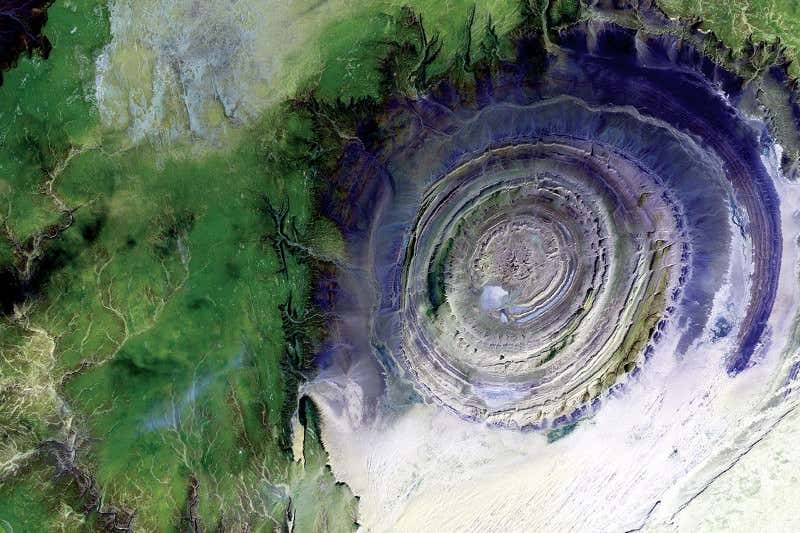
IF YOU ever find yourself in orbit, you may notice a giant eye staring back at you from Earth: the Eye of the Sahara. Located near Ouadane in Mauritania and also called the Richat structure, it was captured here by the Landsat 7 satellite.
A landmark for space travellers since the early days, the Eye of the Sahara is around 40 kilometres in diameter and looks like a bullseye in the otherwise featureless desert – not easily missed! The concentric rings are made up of alternating types of rock of different ages, with the most erosion-resistant rocks forming the ridges.
Advertisement
The manner of its birth has been hotly contested. At first there were suggestions that it was the result of a meteorite impact – based on the circular rings – or a volcanic eruption, but geological evidence to back them was lacking.
The current view is that the Eye of the Sahara is a deeply eroded, collapsed geological dome – a structure formed when a roundish part of the Earth’s surface is elevated. But why it is so unusually circular remains a mystery.
This article appeared in print under the headline “Earth’s eyeball”
Topics: