(Image: ESA/Rosetta/Navcam)
Read more: Click here to read the original, longer version of this story.
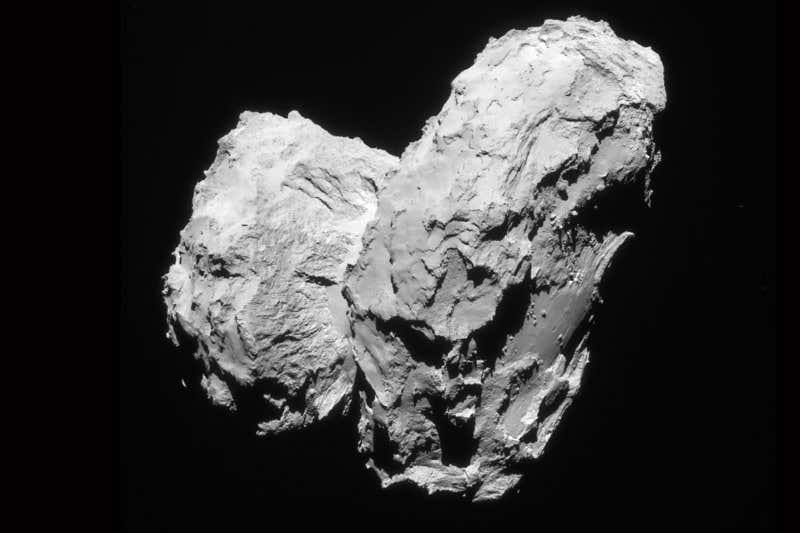
CRASHING in slow-mo. The Rosetta spacecraft has confirmed that comet 67P/Churyumov-Gerasimenko was formed by two small bodies coming together at less than walking speed.
Advertisement
Matteo Massironi, a geologist at the University of Padova, Italy, and his colleagues have studied high-resolution images of the comet. Layers of material – called strata – are visible, but their 3D arrangement makes them look like two onions stuck side by side. This confirms that the comet was once two separate rocks.
The strata of 67P could only be preserved if its two halves collided at about 1 metre per second – a little slower than most people walk (Nature, DOI: 10.1038/nature15511).
This article appeared in print under the headline “Two became one to form comet 67P”
Topics: