The West Pole Beacon off the UK’s south coast records weather and sea data PJ Davy
Chimet
Mining
The Leaf Label
Every time Craig Kirkpatrick-Whitby speaks, he has to hold down a button on a device in his neck, which stops air coming out of a hole in his throat. He explains the opening-closing mechanism before he reinserts the white plastic disc. It is a heat and moisture exchanger, implanted to allow him to retain moisture in his lungs.
“I’ve had cancer three times in the last four-and-a-half years,” he says, his voice now generated by a tracheoesophageal voice prosthesis embedded in the back wall of his neck. “I have no voice box, no lymph glands, no thyroid glands. They rebuilt my face using skin and tissue from my left leg. I couldn’t speak at all for more than two years,” he says. “But I don’t want to be defined by my cancer. I want to do interesting stuff.”
Advertisement
That “interesting stuff” includes innovative music, drawing on science. An investor, data scientist, sailor, ex-boxer, photographer and musician, Kirkpatrick-Whitby is the creative, curious mind driving Chimet, the first album by the musical collective Mining.
The instrumental pieces were built around more than 2000 sampled data streams from West Pole Beacon, known as Chimet, a navigation marker off the coast of Chichester in West Sussex, UK, that records meteorological and nautical information.
The data was captured over seven days in October 2017, as Hurricane Ophelia and Storm Brian lashed the country. Each 2-second period of music represents a 5-minute snapshot of data, including wind speed and direction, atmospheric temperature, water temperature and wave height.
In 2016, Kirkpatrick-Whitby and sound designer PJ Davy, another member of the Mining collective, developed a “sound engine” using Max software, where algorithms organise the mined data samples into streams, which then create outgoing signals that trigger the desired intensity, notation and rhythms of a sound palette to generate music.
“I’m an investment banker,” says Kirkpatrick-Whitby. “That’s where my knowledge of data comes from. I live in West Sussex, about 5 nautical miles away from Chimet. I’d been coming down to this area of the south coast for sailing and windsurfing every weekend since the 1970s, which is where I saw Chimet. I’ve been interested in electronic music all my life and I’d been tracking storms and capturing data. When I looked at the charts from Chimet, it was very obvious to me that it looked like music.”
Musician Matthew Bourne, the third member of Mining, later improvised piano over the atmospheric soundscape, with a cello and a Memorymoog synthesiser added for texture. Chimet doesn’t contain direct audio recordings, but is more an evocation of a storm, a meditative, eerie music of drones, pulses and clicks reminiscent of the Blade Runner soundtracks or Brian Eno’s ambient work.
“There is the ‘Mother Nature’-orchestrated music and the ‘human nature’ [orchestrated music], which reinforces the feelings of the storms,” explains Kirkpatrick-Whitby. “We wanted to create an experience that evoked the feelings of being on the water or the beach, and being in the weather.”
As well as terrifyingly strong winds, Hurricane Ophelia and Storm Brian also brought dust storms and widespread damage. But Kirkpatrick-Whitby enjoys a good storm. As someone who says he is very sensitive to music and weather, he suggests that he may experience it through his body more than other people do. “My senses are enlivened by it. Weather is incredible,” he says. “I like a storm. I love snow. I love ice. These are all things that make you feel alive and sharpen the brain.”
Craig Kirkpatrick-Whitby plans to return to work and make more albums Craig Kirkpatrick-Whitby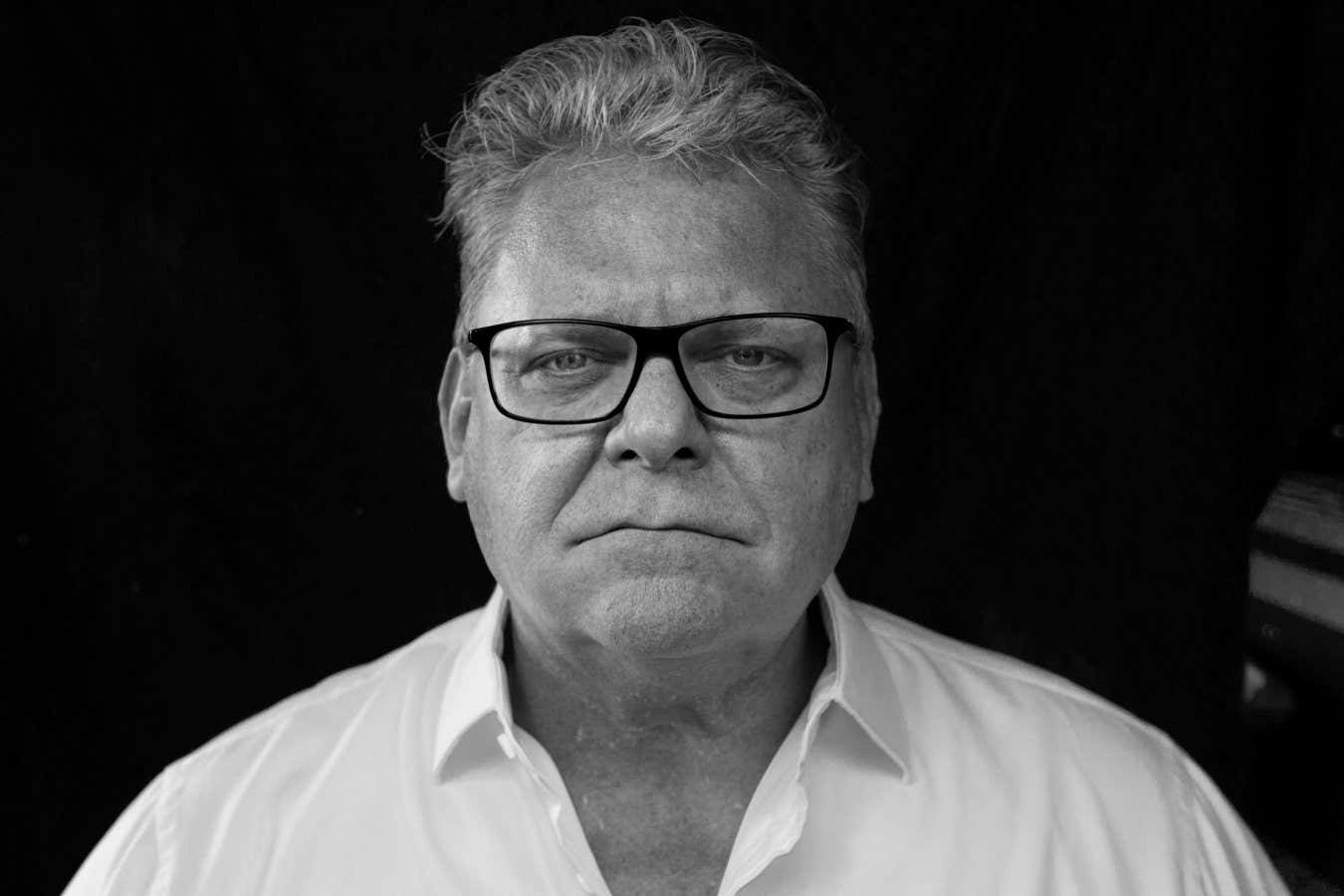
Originally from London, Kirkpatrick-Whitby’s work in global banking has taken him around the world. There has been a restless curiosity about the variety of his other pursuits, too: a one-time boxer, he now enjoys yacht racing and photography. His 6000-strong CD collection ranges from Ravi Shankar to Tangerine Dream, but it mostly consists of electronic music, including dance and what he calls “quite unusual, rare, neoclassical ambience”.
Before his cancer diagnosis, he also sang in bands. “I had a very powerful voice, like Michael Stipe or Eddie Vedder,” he tells me. “Losing your voice is quite astonishing.”
Originally planned for release in 2019, Chimet was delayed by Kirkpatrick-Whitby’s cancer treatment. “I wanted to get the album out before I died,” he says.
The use of data to create music isn’t new, but Kirkpatrick-Whitby believes it hasn’t been done on the scale of Chimet before, with musicians usually working with single strands of data, such as wind speed. “We’ve used 14 separate variables,” he says. “And captured 30,000 data points.”
The process can be applied to all kinds of data, from medical records to that relating to climate change. “As long as I understand the data and can format the data, I can sonify anything,” reckons Kirkpatrick-Whitby. “I’ve got info on satellite data that I’m looking at. I’m also looking at sonifying mathematical conjectures.”
He is also thinking about cancer data. “Before I lost my voice, I was on conference calls with people who run data for the National Health Service [in the UK],” he says. “I recently applied to work with my surgeon on a cancer project. I’ll have access to data and could create music that derives from the statistics from cancer patients across the UK or data that has been professionally anonymised and is allowed to be used.”
At the age of 59 and after a medical all-clear, he hopes to “exist in the normal world” again. “My attitude to life hasn’t really changed. But cancer has changed other people’s perceptions of me,” he says. “I was a noisy, good-fun, centre-of-attention type of bloke. I was quite good-looking, reasonably wealthy. I’ve become more insular, more introverted.
“People pay less attention to what I have to say now because they view me as disabled. My brain is fine, but it does take effort talking,” he says. “People butt in all the time. I end up feeling disappointed by social engagements because I’ve not been able to freely express myself in the ways I used to. I’ve lost a lot of acquaintances because they can’t be bothered.”
He plans to return to work. There will be more music, too, with plans under way to record two new albums with Mining. He is also working on his own keyboard compositions.
“I feel blessed to be alive. I was at the Royal Marsden hospital in Chelsea the other day and there was a 12-year-old girl who’d had throat cancer since she was 10 – unbelievable,” he recalls. “I can still walk… I’m vocally disabled but my brain is fine. I can drive a car. I can’t go near water because if I go in, I would fill up with water very quickly,” he chuckles.
“This,” he says, pointing at his augmented throat, “is not ideal. But I’m still alive.”
Graeme Green is a writer based in Derbyshire, UK
Topics:


