Advances in computer science are making physics research more visual than ever.
This gallery of scientifically accurate images was selected by the magazine Physics World from the New Journal of Physics and shows how computer visualisation is changing everything from human bone analysis to simulations of warp bubbles in space.
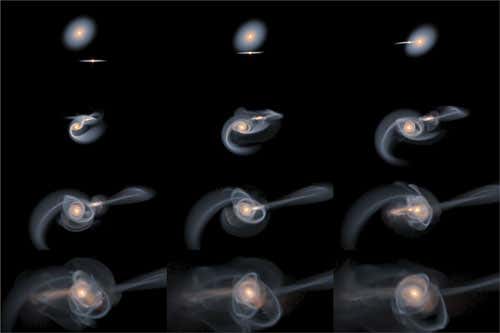
When galaxies collide
This sequence is taken from an animation modelling a galactic collision over 10 billion years. Density, gravitational potential and mass scalar fields are represented by colour, size and geometry.
Image: W Benger
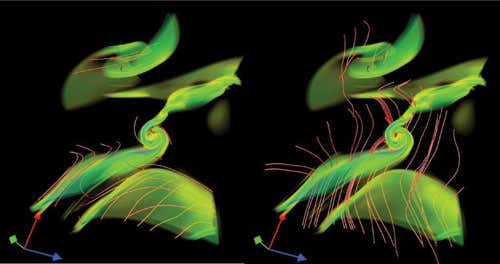
Simulating turbulence
The left-hand image shows current intensity and magnetic field lines in a simulation of the flow of an electrically conducting fluid. Integrated velocity field lines are shown on the right.
Image: P Mininni
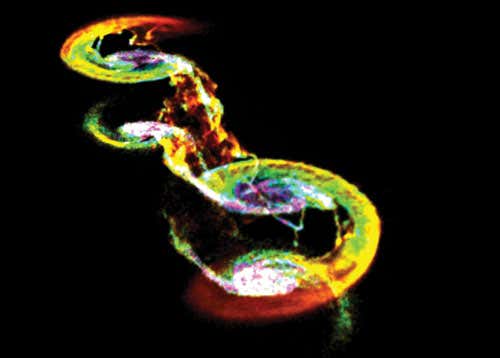
Merging the Milky Way and Andromeda galaxies, looking down on Andromeda.
The tidal interaction forms a spiral structure, throwing off long tidal tails.
Image: J Dubinski
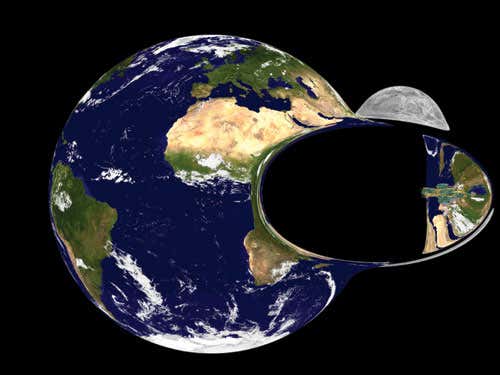
This image shows a simulation of the distortion due to a spaceship inside a warp bubble moving past the Earth and Moon, as seen from space.
Image: H Ruder
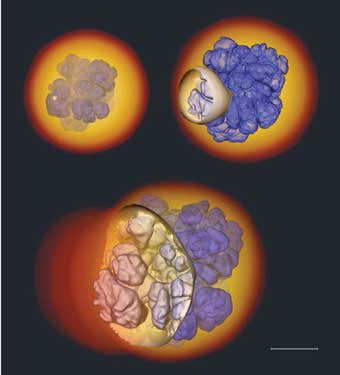
A type 1a supernova, from the onset of detonation through to the ignition of the flame (the blue surface). The white surface is the detonation front.
Image: F K Röpke
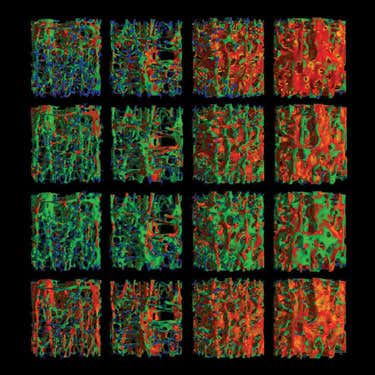
3D images of human bone can help predict fracture risk due to osteoporosis.
The images are of four bone samples imaged multiple times using micro-computing tomography.
Image: C Räth