A team of UK researchers has grown ice crystals in which the water molecules are arranged into pentagons rather than the hexagons found in every natural snowflake.
The unusual ice was grown on a copper surface under a vacuum at -173°C. It owes its pentagonal form to the way the water molecules bond with the underlying copper.
See our gallery of conventional hexagonal snowflakes
Journal reference: Nature Materials (DOI: 10.1038/nmat2403)
Advertisement

A team of UK researchers has created nanoscopic ice rods in which the water molecules are arranged into pentagons and not the hexagons found in all nature.
The ice rods are grown on a copper surface in a vacuum at -173°C. Microscope images of the 1-nanometer-wide rods (red) showed an unusual zigzag arrangement (bright spots in the image). The researchers realised those were parts of the water molecules forced upwards rather than lying flat.
Journal reference: Nature Materials (DOI: 10.1038/nmat2403)
Image: Angelos Michaelides and colleagues
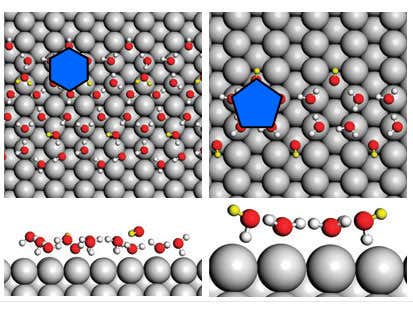
The protruding water molecules are most likely the result of the arrangement of molecules into pentagons rather than hexagons. The pentagons form because of the way the water molecules bond to the underlying copper.
Image: Angelos Michaelides and colleagues
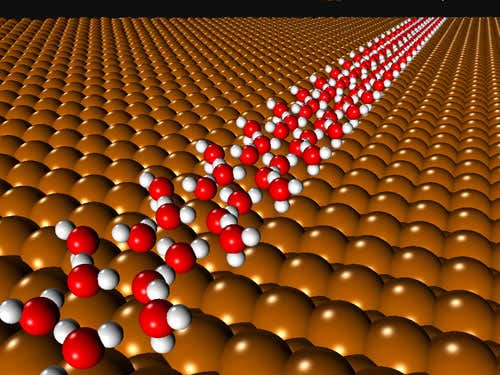
Pentagonal ice can only form into long rods – if more water was present and an ice sheet formed, the ice would revert to hexagonal form.
The water molecules (hydrogen in white, oxygen in red) can be seen here, attached to an underlying copper surface (brown spheres).
Image: Angelos Michaelides and colleagues

In nature icecrystals like snowflakes can form into an exotic variety of shapes, but they are always hexagonally symmetrical.
See our stunning gallery of hexagonal snowflakes
Image: Kenneth Libbrecht