Many big observatories point a single laser at the sky to measure atmospheric turbulence. Recently, the Gemini South telescope tested a five-laser system, reports Kelly Beatty of Sky & Telescope magazine.

Many major observatories already have – or are developing – systems that use powerful lasers to project pinpoints of light high in the atmosphere. These serve as artificial guide stars for adaptive-optics systems that correct for less-than-ideal “seeing” (atmospheric turbulence). When everything works, celestial targets can be recorded with astonishing clarity.
(Image: Sarah Anderson/W. M. Keck Observatory)
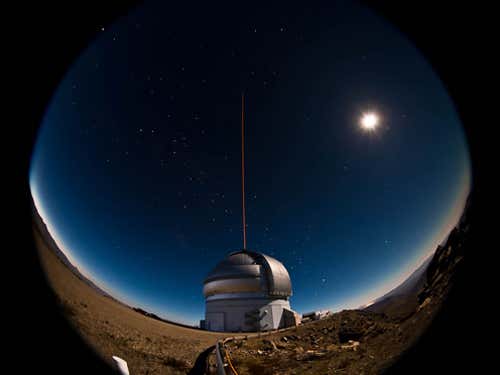
Most observatories use a single laser-generated beacon, which limits how much of the telescopic field can be manipulated using adaptive optics. Typical targets are discrete objects like close-spaced double stars or compact clusters. But a new development at Gemini South observatory (shown) high in the Chilean Andes holds promise for extending adaptive optics’ high resolution to much wider fields.
(Image: Gemini Observatory/AURA)

On 22 January, researchers test-fired a laser that created a tight five-star “constellation” in the sky above Cerro Pachón. With an output of 50 watts – 1000 times more powerful than a typical handheld unit – the laser is tuned to sodium atoms’ strong yellow emission at 589 nanometres. After being split into five separate beams, the laser light illuminates sodium atoms naturally present in a layer within the mesosphere, about 90 kilometres high. Those atoms then fluoresce at the same wavelength to create five artificial stars, each about 1 arcsecond across, at the corners and center of a 1-arcminute square.
(Image: Gemini Observatory/AURA)

Gemini South is the first facility to use this multiple-beam technique with a sodium laser. Project leader Celine d’Orgeville explains that Gemini’s Multi-Conjugate Adaptive Optics (MCAO) system should allow the observatory’s 8.1-metre aperture to record ultrasharp views over fields up to 2 arcminutes across [1/15 of the apparent width of the moon]. Sometime next year astronomers hope to start using the MCAO system to study objects ranging from just-born stars to distant galaxies.
(Image: Gemini Observatory/AURA)

At least two other facilities are pursuing adaptive-optics systems that employ multiple guide stars. In 2007 the European Southern Observatory’s Very Large Telescope tested a system that uses natural guide stars, but its use is limited because of the scarcity of suitable telescopic fields. That same year the MMT Observatory in Arizona (shown) tested a system that uses a powerful green laser to create multiple artificial stars using Rayleigh scattering in the lower atmosphere.
(Image: MMT Observatory/Smithsonian/U of Arizona)