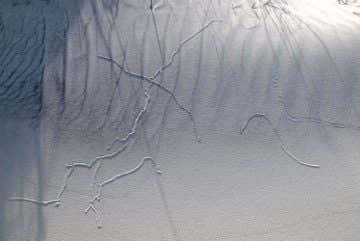
On a March visit to the North Carolina seashore, I encountered this tableau (see photo) of two types of markings on an otherwise pristine sand dune. One of them seems to be a trail left in the surface by a passing arthropod. The other has a mound-like relief and it appears to have been made by the sand being pushed upwards from below. The mounds’ height and width are generally uniform along their length, at perhaps 1 and 1.5 centimetres, respectively; there are branches at several points; and nowhere do there seem to be openings to the surface. Does anyone have an explanation?
A couple of possibilities for this one, according to readers – Ed
• The markings on the sand at the top of the photo are almost certainly ripples. These are symmetrical, suggesting that they have been formed by oscillatory waves. Small variations in elevation across the beach lead to diversion of the incoming tide, leaving some areas with ripples and others, like that in the lower half of the photo, without. The ripples may have flattened or rounded tops, formed when ebb tidal currents wash over the crests.
Advertisement
Jon Noad, Calgary, Alberta, Canada
• The raised trails on the sand dunes are probably left by reptiles, such as snakes or lizards, which follow their prey just under the surface to avoid detection and then launch to the surface at the very last moment.
Daniel Outeke, London, UK
We pay £25 for every answer published in New Scientist. To answer this question – or ask a new one – email lastword@newscientist.com. Terms and conditions apply.
Please keep your answers concise and include a postal address in order to receive payment for answers, and a daytime telephone number and email address if you have one. We reserve the right to edit items for clarity and style.
New Scientist Ltd reserves all rights to reuse question and answer material that has been submitted by readers in any medium or in any format.
You can also submit answers by post to: The Last Word, New Scientist, 110 High Holborn, London WC1V 6EU, UK.