Subscribe now

Will the planets of our solar system ever line up in a row? (Part 2)

Only every 100 billion years, says one reader - longer than the lifetime of the current stable solar system

19 July 2023

MNN37P Illustration comparing the planets of the Solar System and the Sun on the same scale. The planets are shown to scale relative to each other but their distances are not. From left to right the bodies are: the Sun, Mercury, Venus, Earth, Mars, Jupiter, Saturn, Uranus and Neptune.

Science Photo Library/Alamy
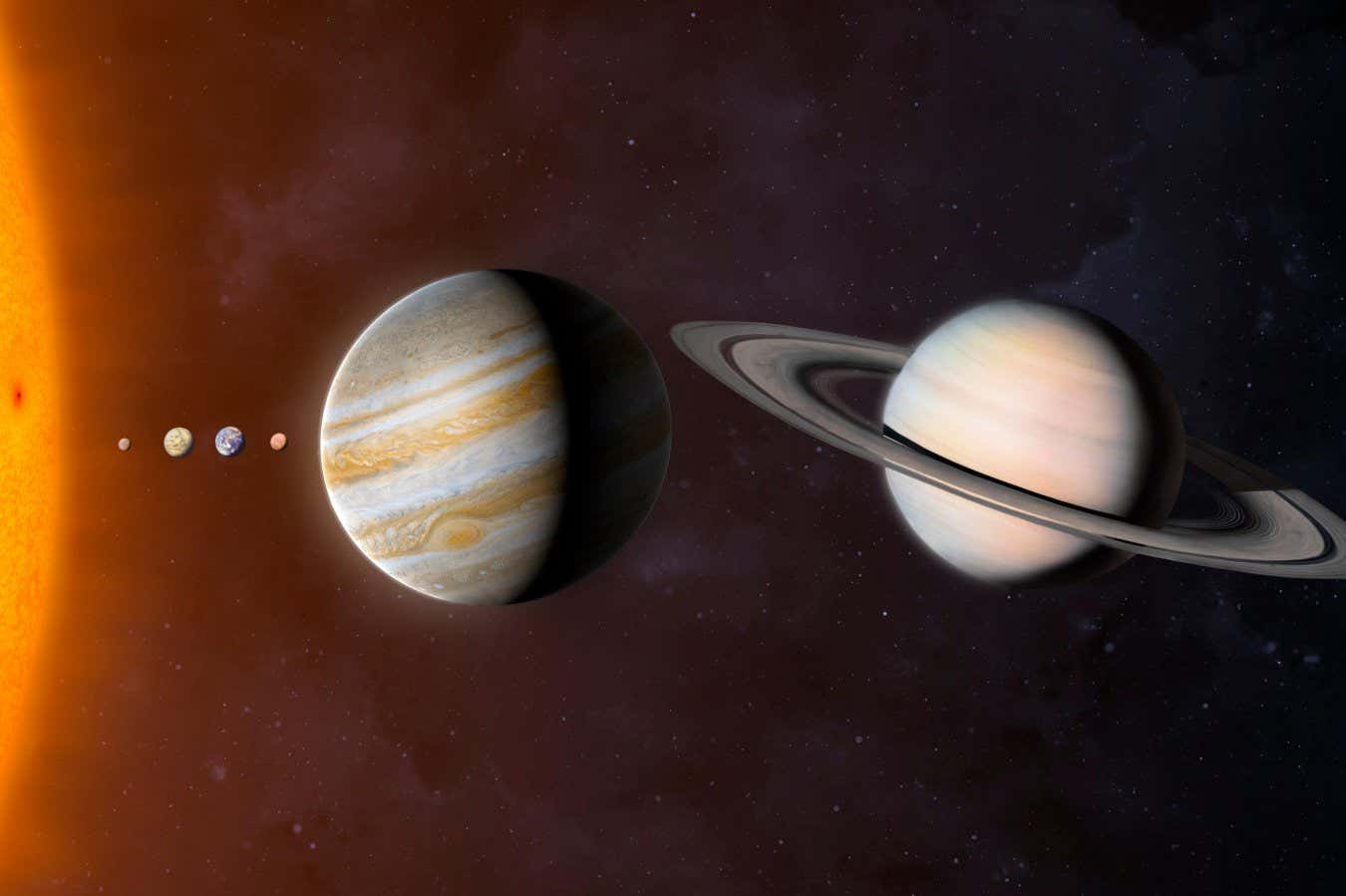
Will there ever be a time when all the planets of our solar system line up in a row, one behind the other, as seen from Earth? (continued)

Richard Swifte
Darmstadt, Germany

An exact line-up would mean that each of our seven neighbouring planets eclipses those behind it, which, given their small angular sizes as seen from Earth, is incredibly unlikely.

Realistically, you should allow a lining-up to within at least a few degrees.

As an example, just considering longitude, Mercury (nearest the sun) laps Venus every 0.396 years. Allowing 1.8 degrees of separation gives an arc of 3.6 degrees,…


Sign up to our weekly newsletter

Receive a weekly dose of discovery in your inbox. We'll also keep you up to date with New Scientist events and special offers.

Sign up

To continue reading, subscribe today with our introductory offers

Piano Exit Overlay Banner Mobile Piano Exit Overlay Banner Desktop