From Steve Alker, Rudgwick, West Sussex, UK
Feedback mentions a pub in Cornwall, UK, named for William Cookworthy, the 18th-century chemist who discovered china clay in the area (5 August). It would be nice if there were also one called The Walton named after Hugh Walton, a member and fellow of the Operational Research Society.
In 1974, the English China Clays company announced that Hugh had almost single-handedly saved it from bankruptcy. It had issued stock market warnings and told him he was a very brave man taking on even the consultancy aspects because it might not be able to pay him.
Hugh used an analogue computer called the Simutron, which his firm made, to optimise the blending of clays from, I think, 15 clay pits into 50 or so products, each to a specific formula. His use of the simplex algorithm for optimising planning problems on an analogue machine was astonishingly ahead of its time.
One of the Simutrons used by English China Clays Steve Alker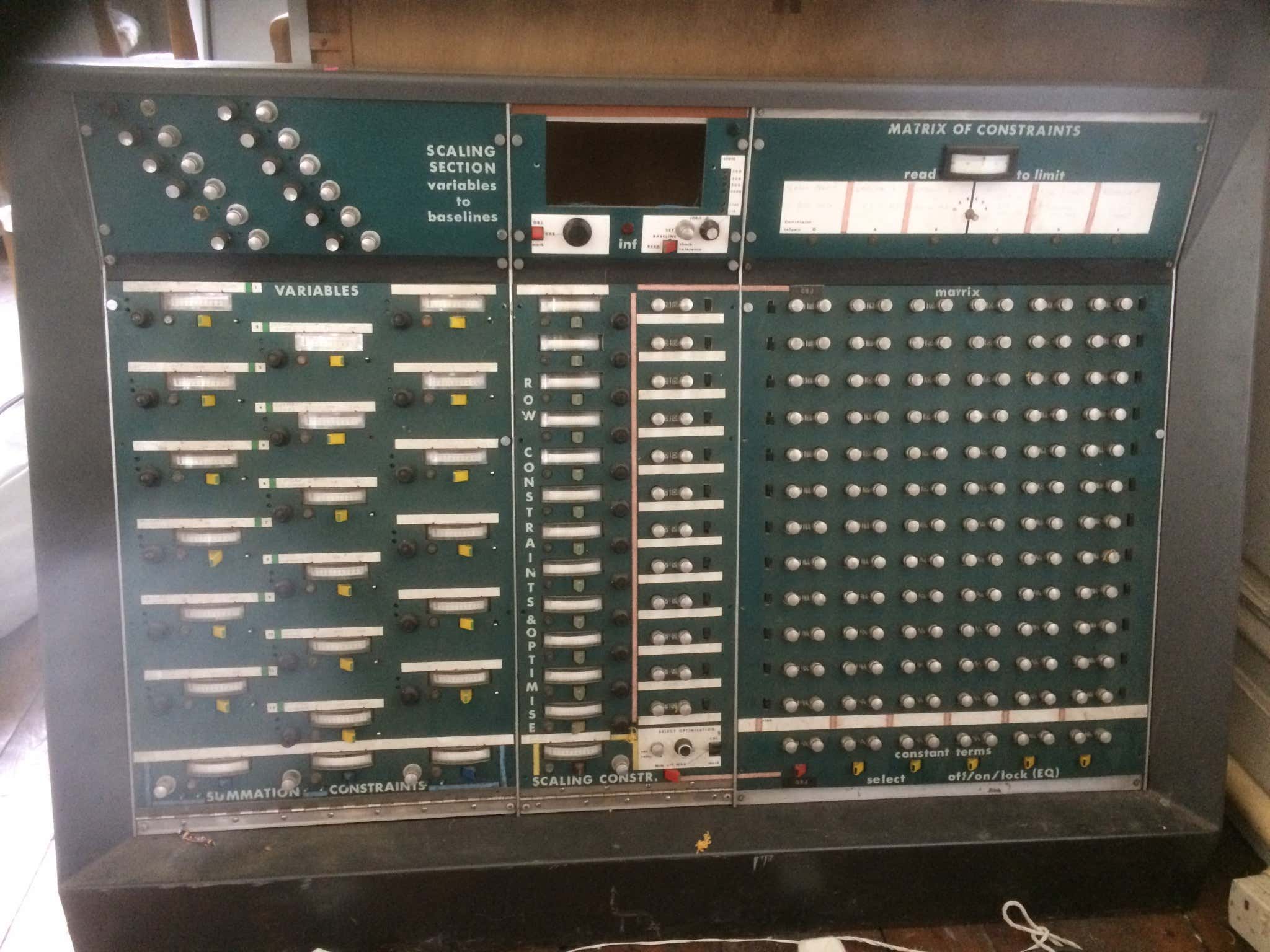
Advertisement
There are 1,307,674,368,000 (that is, 15 factorial) ways of blending 15 clays and the calculation needed to be done thrice daily. English China Clays’ mainframe computer would do it, but it took a week and no one could play with the results. Hugh’s Simutron did it in seconds, right in front of you. He sold the firm two machines at £84,000 each.
Hugh also solved a major labour dispute. The unions wanted a pay rise for 300 workers, and overtime pay at time-and-a-half, of which they required 5 hours a week each. The company wanted to cull them and pay the remainder a lot less. In 1974, that wasn’t going to happen.
Noticing that the needle of the physical meter on the Simutron that showed labour as a constraint on production spent its time banging its end stop during an optimisation, Hugh suggested that the firm kept all its workers, giving them the rise they wanted and also the overtime. “But you can’t do that – you will bankrupt us even faster than we are doing ourselves,” the accountants shouted.
So Hugh spun a pay rise and overtime for 300 workers into the Simutron
– and it showed profits going up by £180,000 (about £1.9 million today). He had spotted that labour was a constraint on profits, not just a cost.
Above is a photograph of one of the machines that English China Clays used until 2001. A few months after its installation, the firm issued a press release saying that its new machines “paid for themselves every six weeks and continued to do so”. The firm was taken off the stock market’s critical list a couple of months later.
I know all this because I worked for Hugh in 1979 and learned a bit about operational research. I have now resurrected his work and his firm, with his family’s consent. My iSimutron interface will shortly be the world’s only analogue simplex simulation interface.
