Subscribe now

Letters archive

Join the conversation in New Scientist's Letters section, where readers can share their thoughts and opinions on articles and see responses from experts and enthusiasts across a range of science topics. To submit a letter, please see our terms and email letters@newscientist.com


28 November 2007

Anaesthetists' interest

From Joe Power

It is not befitting of a journal of your high standard to open this article by describing anaesthetists of having a somewhat boring reputation and accusing a group of them (and by implication the rest of the profession) of attempting to derail the global arms treaty (20 October, p 50) . The attitude betrayed in …

28 November 2007

Spooky socks

From Harry Collins

Many have puzzled over entangled quantum socks (Letters since 22 September, p 25 ). Interestingly, the very instant I put a sock on my right foot its partner becomes a left sock.

28 November 2007

For the record

• We mentioned the "Pittsburgh Supercomputing Center at Carnegie Mellon University in Pennsylvania" (3 November, p 30) : the centre is a joint effort of Carnegie Mellon, the University of Pittsburgh and Westinghouse Electric Company. • Simon Goodman does not work in Munich as we stated in the article on Germany's biotech industry ( 17 …

28 November 2007

Reason or religion

From Ron Gibson, Irvine, California, US

You say that trying to tell people how they should think is likely to alienate them (10 November, p 3) . I'll respond with a quote from a popular bumper sticker: "Minds are like parachutes, they only work when they are open". After a lengthy and absurd paragraph on how religion does not engender hatred …

28 November 2007

Total recycling

From Trevor Pitts

Will all waste be recycled in the future, "down to the last gram" (20 October, p 30) ? As a founder (in 1974) and former CEO of Zero Waste Systems in Oakland, California, I have some experience here. Our motto was "there is no away to throw things to" and we were very idealistic while …

28 November 2007

If you're so smart...

From Max Hedt

To win $25,000 for proving that a "universal computer" – one that could solve any problem in mathematics given enough time and memory – could be built from biological molecules such as DNA, seems a rather easy earn (27 October, p 29) . There already are biological, DNA-based computing systems that are smart enough to …

28 November 2007

Altruism's limits

From Paul Wilson

In your editorial about multi-level selection, you suggest that altruism might replace "unrestrained" market forces (3 November, p 3) . This hope ignores the fact that the groups competing to be "selected" in the ecosystem of a global marketplace are corporations and economic areas. Within these groups, cooperation and altruism do indeed improve their fitness, …

28 November 2007

Disallowed time

From Lee Cottrell

I have often read of the time-travel paradox, in which you go back in time and kill your grandparents, thus deleting your existence. But what makes people think that nature would allow them to kill their grandparents? Wouldn't every opportunity you took to kill them likely be thwarted? The very fact that you exist means …

28 November 2007

Second-hand smoke

From Deborah Arnott, ASH (UK)

Your editorial and article highlight the dangers of exaggerating the health impact of exposure to second-hand smoke ( 10 November, p 3 and p 8 ). ASH (UK) endorses your conclusion that bad science can never be justified. ASH, unlike some organisations, has never asserted that a single 30-minute exposure to second-hand smoke is enough …

28 November 2007

Reason or religion

From Mark Vernon

You nobly resist the temptation to give science the victory over religion, but I dispute your overly generous concessions (10 November, p 3) . In making the practical point that trying to change how people think is likely to alienate them, you abdicate the scientific responsibility to distinguish truth from falsehood. It is not a …

28 November 2007

Bug vs superbug

From Cheryl Hill

Clearly we need a winning strategy to nip the "superbug" problem in the bud before it becomes too prevalent in the community (29 September, p 37) . Am I the only one to have maintained an interest in the development of phages as our best defence against antibiotic-resistant bacteria? They have long been used to …

28 November 2007

Lighting the deep

From Edith Widder, Ocean Research & Conservation Association

Answering the phone one day early in my career researching marine bioluminescence (27 October, p 30) , I found myself talking to a distraught physicist. He explained his part in the Deep Underwater Muon and Neutrino Detection (DUMAND) project, attempting to detect Cerenkov radiation using sensitive light detectors deep in the ocean, far away from …

28 November 2007

Fertility possibility

From Jonathan West, Peninsular Centre for Reproductive Medicine

We should not be surprised that the over-the-counter "food supplement" DHEA may improve the response of the ovaries during IVF treatment (27 October, p 12) . It has androgenic (testosterone-like) effects, which are known to increase the sensitivity of receptors in the ovary to FSH – the hormone injected to stimulate egg production in IVF …
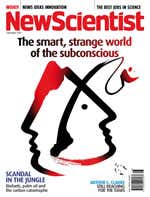
Issue no. 2632 published 1 December 2007

Sign up to our weekly newsletter

Receive a weekly dose of discovery in your inbox. We'll also keep you up to date with New Scientist events and special offers.

Sign up
Piano Exit Overlay Banner Mobile Piano Exit Overlay Banner Desktop