Subscribe now

Letters archive

Join the conversation in New Scientist's Letters section, where readers can share their thoughts and opinions on articles and see responses from experts and enthusiasts across a range of science topics. To submit a letter, please see our terms and email letters@newscientist.com


22 June 2011

P = NP?

From Derek Bolton

Your article "The hardest problem" (4 June, p 36) made it sound as though proving P=NP would immediately allow us to solve many problems that have stumped computer science, whether timetabling, travelling salesman routes or sudokus. But actually it would only tell us that an algorithm to solve the problem quickly exists in each case. …
22 June 2011

Man bites dog

From Susan Grote

When talking about the reasons for domesticating animals, why assume that dogs were not eaten by early humans (28 May, p 32) ? Dog meat is on the menu in many parts of the world. In fact, since domesticated dogs soon reach sexual maturity and reproduce rapidly, an early human family would have been overrun …

22 June 2011

No silver lining

From Alan Sangster

Did Erle C. Ellis have his rose-tinted spectacles on when he wrote "A world of our making" (11 June, p 26) ? While his analysis of the evolution of the Anthropocene is coherent and informative, his acceptance of it, which is more political than scientific, is baffling. Anyone who can write, "It is no longer …

22 June 2011

Reading minds

From John Kioustelidis

Duncan Graham-Rowe suggested that understanding how the brain turns thoughts into words will pave the way for machines that read minds (28 May, p 40) . However, much of thinking is imaginal. Einstein, for instance, said in a letter to mathematician Jacques Hadamard published in The Psychology of Invention in the Mathematical Field (Dover, 1965): …

22 June 2011

Not so heavy

From Eli Rayfield

In your article on the possibility of cellphones being carcinogenic (11 June, p 7) , the researchers class using a phone for 30 minutes a day as heavy use. It may well have been in the late 1990s, but not any more; now that many people use only cellphones, a couple of hours a day …

22 June 2011

Apocalypse thinking

From Christine McNulty

Michael Shermer is spot on about the human brain's pattern-seeking abilities, but not about the reasons why people engage in "apocalyptic thinking" (4 June, p 30) . When we test imaginary scenarios in the theatre of the mind, as philosopher Karl Popper said, we are "letting our ideas die in our stead". Apocalyptic thinking is …

22 June 2011

Low-fat worries

From Robert Bryan

Reading that the hunger hormone ghrelin can be suppressed just by believing a low-calorie drink is a high-calorie treat (4 June, p 21) reinforces my concern that the opposite may happen, and that foods labelled as low fat may do more harm than good. Consumers may believe such foods contain fewer calories than they do, …

22 June 2011

The cost of money

From Pam Lunn

With all the number-crunching on power-hungry computers needed to run the virtual money mentioned in your technology special (4 June, p 23) I have a question: just what is the carbon footprint of a bitcoin?

22 June 2011

Decades ahead

From Denis Weaire, Trinity College Dublin

In "When science gets it wrong" (21 May, p 28) you presented the excellent example of the diffraction limit in microscopy, surpassed in 1984 by the invention of the near-field scanning optical microscope. At a conceptual level, this technique was described in publications by Edward H. Synge, who corresponded on the subject with Albert Einstein, …

22 June 2011

Hot wheels

From Richard Holroyd

Martin Savage, in his Pythonesque theorising on the difference in train speeds in summer and winter (21 May, p 25) , forgets that not only will the metal rails be longer in summer, but the metal wheels of the engine also get bigger to compensate. Therefore, provided the wheels are rotating at the same speed …

22 June 2011

Wow!

From Tom Heydeman

I was impressed to see on the back cover advertisement (28 May) that Mercedes-Benz is celebrating "125! years of innovation". Factorial 125, the number of years claimed, is more than 10 200 , so the company started to innovate unimaginable aeons before the big bang.

22 June 2011

Canon fodder

From Brian Parker

One wonders what ecclesiastical diet is responsible for the proposal to use a "high-powered propane canon as a sound source" for mapping caves (4 June, p 26) .

22 June 2011

Got the T-shirt

From Arnold Gijsen

On the same day as "The grand delusion" feature (14 May, p 35) appeared, I collected a T-shirt I had ordered. Uncannily, its logo is: "What You Know, Ain't So".

22 June 2011

Robo sock

From David Crichton

I was puzzled at the idea of having to program a robot to recognise a pair of slippers or an article of clothing (21 May, p 18) . Surely the answer is a washing label with instructions for the robot.

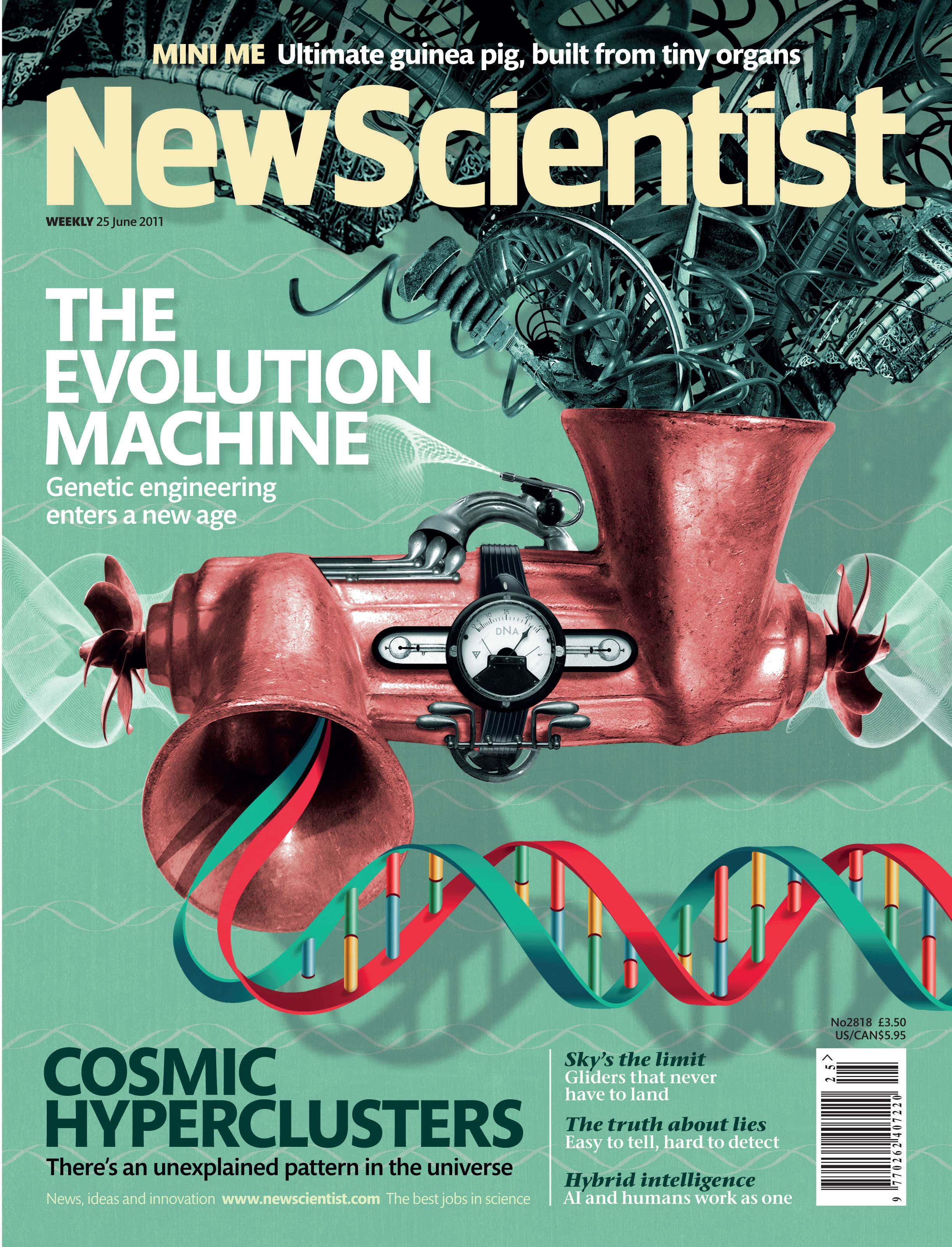
Issue no. 2818 published 25 June 2011

Sign up to our weekly newsletter

Receive a weekly dose of discovery in your inbox. We'll also keep you up to date with New Scientist events and special offers.

Sign up
Piano Exit Overlay Banner Mobile Piano Exit Overlay Banner Desktop