Subscribe now

Letters archive

Join the conversation in New Scientist's Letters section, where readers can share their thoughts and opinions on articles and see responses from experts and enthusiasts across a range of science topics. To submit a letter, please see our terms and email letters@newscientist.com


12 October 2011

Fast, faster, fastest?

From Tony Cheney

Perhaps an explanation for the anomalous velocity of neutrinos from CERN to Gran Sasso in Italy (1 October, p6) , compared with the velocity of light in a vacuum, depends on what you mean by a vacuum. Measurements of the speed of light in a vacuum may have a hidden error. We all know these …

12 October 2011

Risky business

From John Baker

So, scientists in Italy are being prosecuted for failing to predict an earthquake (24 September, p 34) . May I predict the number of prosecutions relating to other failures of risk management? Investment bankers in charge of disaster banks – no prosecutions; any public servants (other than scientists), for anything – none; politicians responsible for …

12 October 2011

Brain essentials

From Michael Crawford, Imperial College London

Your article "A brief history of the brain" (24 September, p 40) was wonderful, but missed an important point. During its first 2.5 billion years, life was largely anaerobic. It is likely that during this phase, synthesis of docosahexaenoic acid (DHA) would have been limited. DHA is a major essential fatty acid constituent of the …

12 October 2011

Snap the theory?

From Richard Snell

My interest in the account of the thoughts of cosmologist Max Tegmark was tempered by something more than surprise – I learned that the rejection of the early cosmic inflation or of the Copernican principle, that Earth does not occupy a special place in the universe, "are anathema to cosmology", (24 September, p 8) . …

12 October 2011

Fish that glow

From William Price, University of Wollongong

I was quoted in your report on a transgenic fish that fluoresces when exposed to oestrogenically active chemical contaminants (11 June, p 16) . My comment, as used, is slightly ambiguous. To clarify, the creation of a transgenic fish that glows in the presence of oestrogenically active compounds in the water is an advance, and …

12 October 2011

Pull of the tide

From Alan South

It is easy to fall into the trap of believing an overlooked technology is the magic solution to our energy needs, and I got the impression that your article on tidal power (17 September, p 48) was teetering on its edge. A renewable future will need many different energy sources. The biggest challenge is matching …

12 October 2011

Anti-science doubt

From Quentin de la Bedoyere, Science editor, Catholic Herald

As someone charged with communicating science in a Catholic newspaper, I am not helped by Royal Society president Paul Nurse's attacks on anti-science (17 September, p 5) . The Catholic church is on official record as saying that material human evolution is compatible with religious faith. But science, by definition, has nothing to say about …
12 October 2011

Last word on Jon

From Carolyn Hunt

Come, now, do you really think prolific Last Word correspondent Jon Richfield of Somerset West, South Africa, is a real person ( 3 September, p 57 )? Nobody knows everything about everything, as "Jon" seems to. My guess is that the faculty of a nearby university get together during the tea break to come up …

12 October 2011

The definite article

From Michael Swan

James W. Pennebaker says that people who make relatively high use of definite and indefinite articles tend to be "more organised, emotionally stable, conscientious, politically conservative and older" (3 September, p 42) . His feature contains just over five articles per 100 words. Without a baseline figure, it is difficult to know where this puts …

12 October 2011

Vital vaccine

From Sam Morris

While there may be good reasons to be cautious about large-scale HPV vaccination programmes (1 October, p 28) , the potential human cost of postponing such schemes should not be underestimated. Extensive clinical programmes of up to six years support the safety profile of HPV vaccines. Indeed, how long they remain effective has not yet …

12 October 2011

Elbow grease

From Hilary Gee

Concerning your story "A wrinkle pill that feeds your genes" (24 September, p 10) , never mind the wrinkles, what about doing something to help creaky joints? The most common form of arthritis involves erosion of cartilage. Arthritic people spend huge amounts of money on glucosamine and chondroitin supplements in the hope that they might …

12 October 2011

For the record

• The final quote in the story on brain waves (1 October, p 19) should have been attributed to Bernard Balleine at the University of Sydney. • The DOI in the story linking epigenetic changes to schizophrenia and bipolar disorder (1 October, p 16) should have been 10.1093/hmg/ddr416 . • Paul Drayson, in the story …

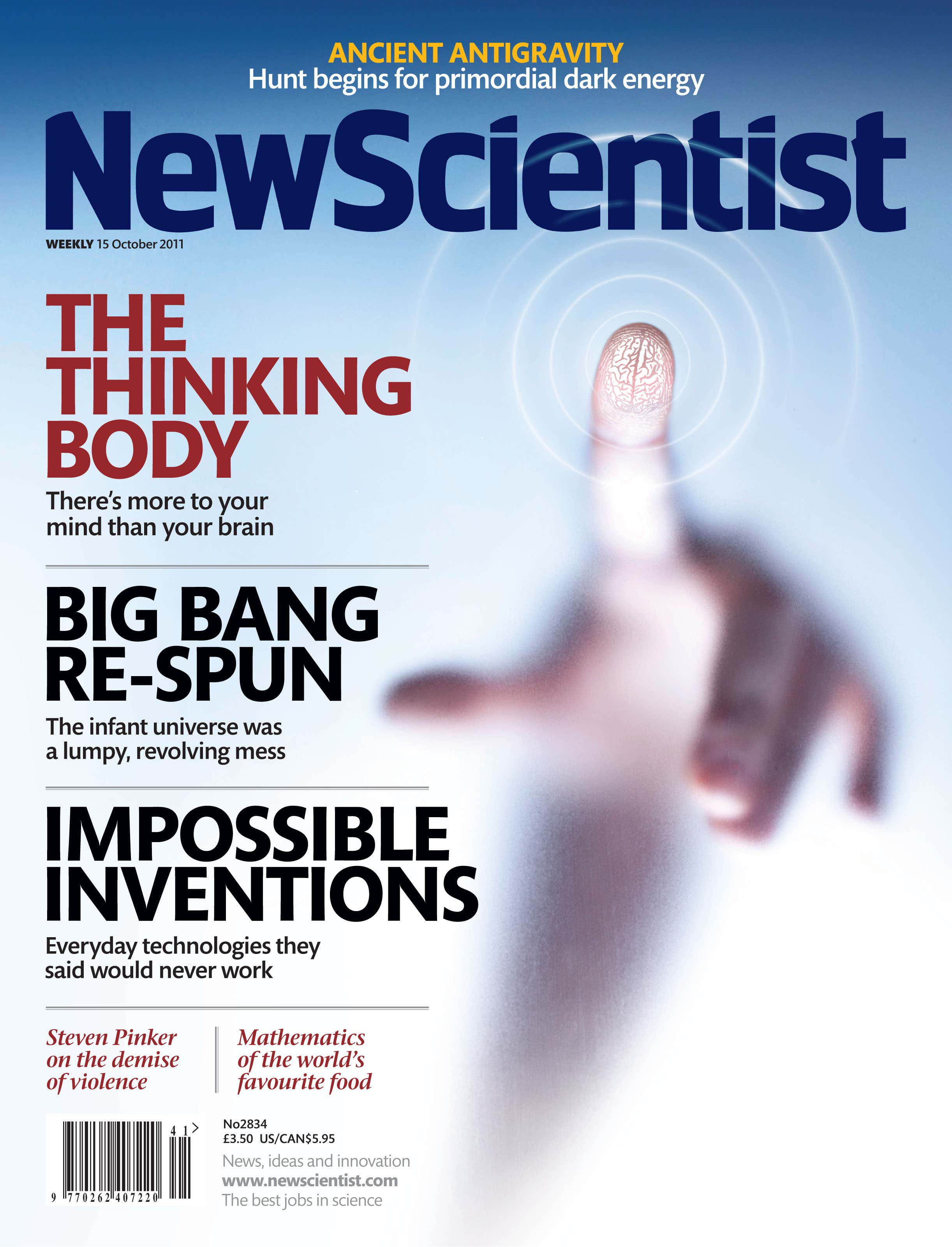
Issue no. 2834 published 15 October 2011

Sign up to our weekly newsletter

Receive a weekly dose of discovery in your inbox. We'll also keep you up to date with New Scientist events and special offers.

Sign up
Piano Exit Overlay Banner Mobile Piano Exit Overlay Banner Desktop