Subscribe now

Letters archive

Join the conversation in New Scientist's Letters section, where readers can share their thoughts and opinions on articles and see responses from experts and enthusiasts across a range of science topics. To submit a letter, please see our terms and email letters@newscientist.com


30 November 2011

Honest bankers

From Andrew Powell

I find Ian Stewart's use of "the set of all honest bankers" as an example of an empty set (19 November, p 44) not in the least amusing, and deeply insulting to the hundreds of thousands of men and women in banking who have devoted their careers to helping customers, whether they be in the …

30 November 2011

Speed checks

From James Traver

In the story on further observations of neutrinos beating the speed of light (newscientist.com/article/dn21188) , Luca Stanco of the National Institute of Nuclear Physics in Italy says: "I'm not so happy. From a theoretical point of view, it is not so appealing. I still feel that another experiment should make the measurement before I will …

30 November 2011

Just say no

From Ben Butler

Reading Susan Watts's piece on the use of cognitive-enhancing drugs (19 November, p 32) , I was both excited and shocked. I am studying management accountancy, and happy to consider things that would give me an edge over other students. Yet performance-enhancing drugs are, for me, a step too far. The ethics of using drugs …

30 November 2011

Cost of meat

From Mario Herrero, International Livestock Research Institute

Further to your look at the environmental impact of global meat consumption (19 November, p 12) , I would like to take issue with the claim that "80 per cent of agricultural emissions come from meat production". In total, the agricultural sector emits around 25 to 32 per cent of global anthropogenic greenhouse gas emissions. …
30 November 2011

Hero to zero

From Guy Cox

It is a shame that the fascinating article on zero (19 November, p 41) did not mention the 6th-century monk and scholar Dionysius Exiguus. Although he wimped out big time by not having a year zero when he split the calendar into BC and AD, instead starting the Christian era on 25 March 1 BC, …

30 November 2011

Taste test

From Daniel Shamaun

There are currently over 7 billion people on this planet, and almost as many working taste sensors. Do we really need a "magnetic tongue" to do the job for us ( 5 November, p 23 )? Considering food manufacturers are making products for humans, surely the human tongue is the best judge of flavour.

30 November 2011

Early innovator

From Caroline Herzenberg

I was interested to read about Chinese pharmacologist Tu Youyou, who received the 2011 Lasker award for the discovery of artemisinin, an antimalarial drug that has helped to save millions of lives (12 November, p 46) . Tu led the effort in China that led to the development of artemisinin from extracts of the plant …

30 November 2011

I quit

From Dominic Kirkham

Like other readers, I was shocked, but not surprised, by the utterly naive letter from Quentin de la Bedoyere asserting that "science, by definition, has nothing to say about the spiritual aspects of humans" (15 October, p 33) . As a Roman Catholic priest who had been religious for 30 years, this is an attitude …

30 November 2011

Animal farm

From Felicity Allan

In response to Peter Morris's letter about donating his mortal remains to a body farm rather than opting for a traditional burial or cremation (19 November, p 38) , I suggest he looks at the University of Central Lancashire in Preston, UK, which has a body farm, or at least something their website calls TRACES …

30 November 2011

At sixes and sevens

From Roger Calvert

You report on an artist who depicted mountains on Earth as 10 7 centimetres rather than the more accurate 10 6 centimetres, because "7 was so nice and lucky" (12 November, p 52) . Surely this could have been resolved without geo-engineering by using millimetres, the preferred SI sub-multiple.

30 November 2011

Endless oceans?

From Eric Kvaalen

In his review of Robert Laughlin's book Powering the Future , Fred Pearce summarises the author's view as "ultimately the planet won't care much about our carbon dioxide emissions" because the gas will all end up in the oceans (1 October, p 46) . This is not correct. If we burn all our known fossil-fuel …

30 November 2011

For the record

• The story on atoms forming unexpected bonds at temperatures close to absolute zero (19 November, p 8) should have said that carbon has four electrons in its outer shell.

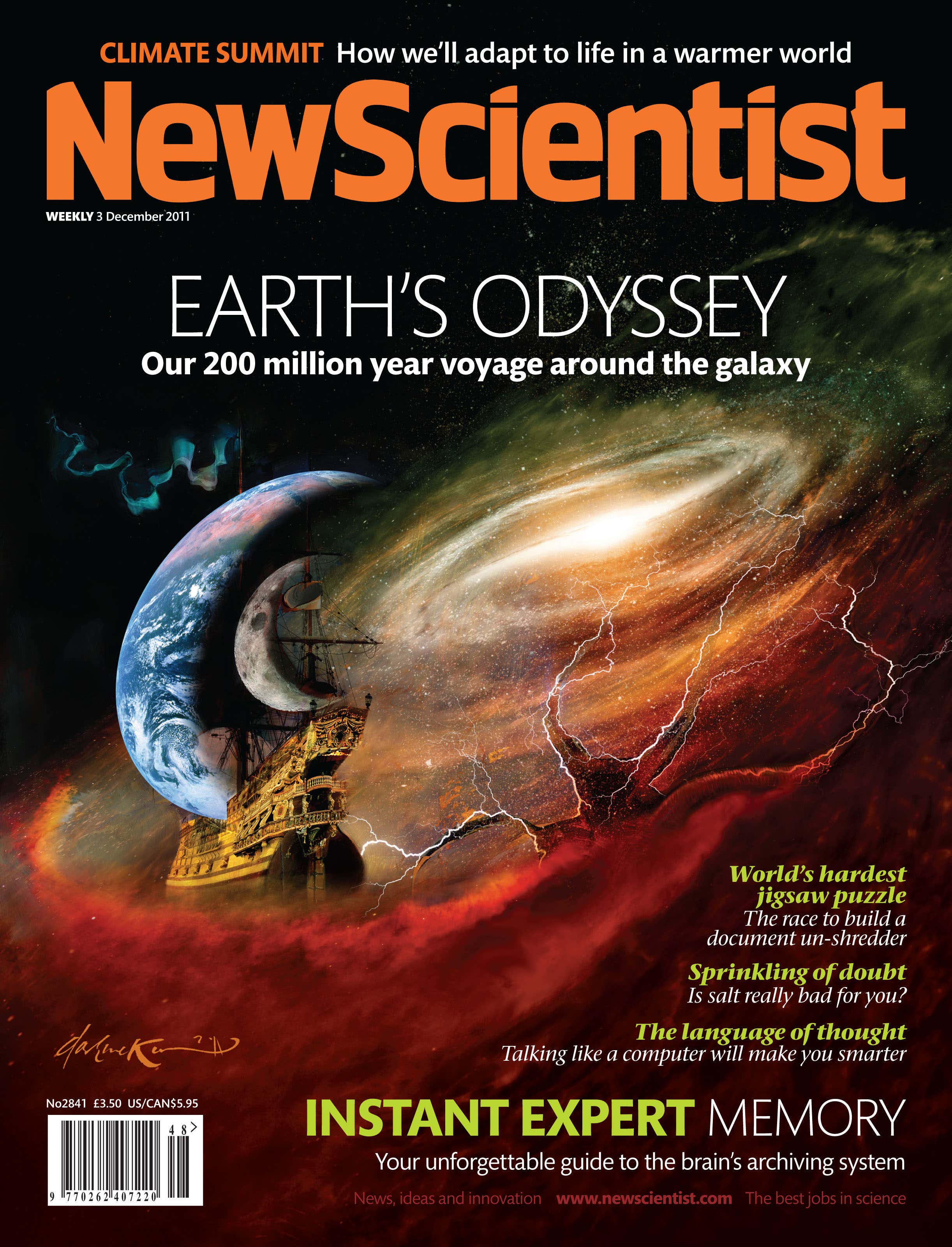
Issue no. 2841 published 3 December 2011

Sign up to our weekly newsletter

Receive a weekly dose of discovery in your inbox. We'll also keep you up to date with New Scientist events and special offers.

Sign up
Piano Exit Overlay Banner Mobile Piano Exit Overlay Banner Desktop