Subscribe now

Letters archive

Join the conversation in New Scientist's Letters section, where readers can share their thoughts and opinions on articles and see responses from experts and enthusiasts across a range of science topics. To submit a letter, please see our terms and email letters@newscientist.com


14 December 2011

Fried mushrooms

From William Bains

Your article on the evolution of warm-bloodedness as a means to avoid fungal infection ends with speculation that global warming might drive the evolution of more warm-tolerant fungi, and lead to a raised risk of fungal pathogens in both mammals and birds (3 December, p 50) . This ignores what the rest of the article …

14 December 2011

Bright idea

From Simon Sellick

James Mitchell Crow's article about thermoelectric solar panels mentioned that photovoltaic (PV) materials respond to only a narrow spectrum of frequencies, the remainder being either too feeble to trigger the photoelectric effect or too energetic and a hindrance (26 November, p 38) . Might the yield be improved by using a trick similar to that …

14 December 2011

Yawns all round

From Giuseppe Sollazzo

Jan Chamier writes that her cat yawns when she or her husband does, and speculates that this is an example of contagious yawning in the animal realm (26 November, p 32) . I have a better example. As I was reading her letter, I started yawning as soon as I read the word "yawn" – …

14 December 2011

Climate blame

From Robert Thorniley-Walker

Maybe popular TV documentaries highlighting life in the polar regions and the impact that global warming will have on the area will initiate what your story called the "climate blame game" (12 November, p 6) . However, from now on legal negligence could be determined simply by looking at the risk assessment, or the lack …

14 December 2011

Heads in the cloud

From Stephen Warman

It is good to see that biologists are beginning to recognise that, as there is more to the nervous system than just what's in your head, the rest of the body has a contribution to make to mental responses (15 October, p 34) . How long before we appreciate the importance of the networks of …

14 December 2011

Shells cracked

From Peter James

Whether or not biologist and mathematician D'Arcy Wentworth Thompson was partial to pasta is doubtless lost to posterity, but he did take a great interest in foraminifera. In his classic work, On Growth and Form (1917), he devotes a whole chapter, "The Spiral Shells of the Foraminifera", to the sort of analysis which Tom Radford …

14 December 2011

Seeing the light

From Adam Justice-Mills

Elena Oancea at Brown University in Providence, Rhode Island, and colleagues have shown a link between skin and the light-sensitive chemical rhodopsin, which is also found in the retina (12 November, p 20) . If we don't get enough sun on our skin during the winter months, could this contribute to making us seasonally depressed? …

14 December 2011

Net gain

From William Hughes-Games

So the fish stocks in the Canadian Grand Banks are finally recovering (30 July, p 5) . A smart fisheries department would now put half the area out of bounds, permanently. Imagine getting the fish stocks back, not to what they were in 1930, but to what they were when the Portuguese first arrived in …
14 December 2011

Man strokes fish

From Dan Lufkin

Your report that fish find massage soothing comes as no surprise to scuba divers (19 November, p 7) . Several species seem to find divers interesting, and will often hang around to be scratched and patted. Groupers, in particular, like to have their bellies rubbed. Recently, diving off Little Cayman, I met a grouper about …

14 December 2011

Doubly infinite?

From Hillary Shaw

So our universe is one of 10 500 universes in a multiverse (26 November, p 42) . But what lies beyond the multiverse? Is it just one of 10 500 multiverses in a polyverse? Maybe it's a reversal of the idea from mathematician Augustus De Morgan's poem: "Great fleas have little fleas upon their backs …

14 December 2011

God of many things

From Micky Star

Your article about the workings of the human mind being more akin to quantum, rather than logical, computation echoes the juxtaposition of eastern and western schools of thought (3 September, p 34) . The ways of the west have their roots in rigid, solid, geometric forms, medieval scholars seeing these harmonic principles as the divine …

14 December 2011

Nothing's up

From Tissa Perera

I thought physicists had given up hope when I read "Why nothing matters" in the online version of the editorial to your special issue covering zero, the empty set, electron hole theory, the vacuum and noble gases (newscientist.com/article/mg21228391.300) . It soon became clear though. What physicists need to do is to work on a TON …

14 December 2011

Golden stick

From Hugh Colvin

So ravens pick up sticks in their beaks and wave them about to attract a partner, and develop complex individual vocalisations, behaviours that could be deliberate and intelligent, or simply down to hormonal triggers (3 December, p 16) . I pick up my gold-plated saxophone, stick it in my mouth and wave it about, which …

14 December 2011

For the record

• In the feature "Friend or foe?" (3 December, p 46) , the salt content of a small pot of yogurt should have been given as 0.4 grams. • The story on the discovery of exoplanet Kepler-22b (10 December, p 4) should have said that if it is at the lighter end of the possible …

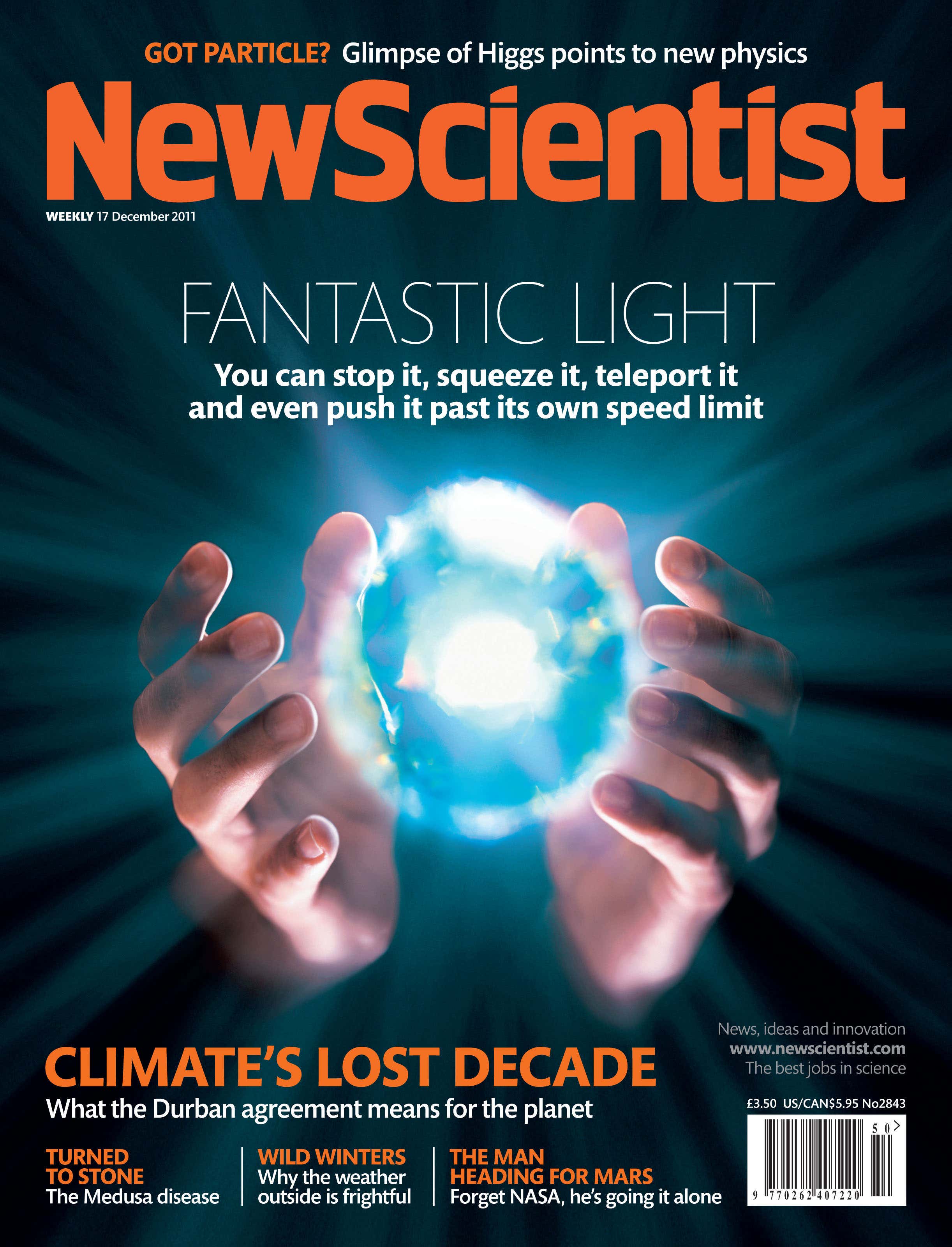
Issue no. 2843 published 17 December 2011

Sign up to our weekly newsletter

Receive a weekly dose of discovery in your inbox. We'll also keep you up to date with New Scientist events and special offers.

Sign up
Piano Exit Overlay Banner Mobile Piano Exit Overlay Banner Desktop