Subscribe now

Letters archive

Join the conversation in New Scientist's Letters section, where readers can share their thoughts and opinions on articles and see responses from experts and enthusiasts across a range of science topics. To submit a letter, please see our terms and email letters@newscientist.com


1 February 2012

Robot wars

From Vivek Burhanpurkar

Helen Greiner's call to design practical robots really hit the nail on the head (21 January, p 20) . I was an early pioneer in autonomous human-scale robotics. My friends often ask me why I'm no longer "in the game", building walking, talking robots. I tell them it's because the world does not need humanoid …

1 February 2012

Capture crucial

From David Hone, Senior climate change adviser, Shell International

The article on the Durban climate talks was a useful synopsis of the current state of affairs (17 December 2011, p 8) , but the diagram analysing the gap between the projected emissions of 55 gigatonnes of carbon dioxide in 2020 and the environmentally desirable goal of 44 gigatonnes suffered from a gap of its …

1 February 2012

Save our helium

From Neil Isaacs

Commercial travel to near space in helium-filled balloons (24/31 December 2011, p 46) is to be deplored. Helium is a non-renewable commodity in demand for superconducting magnets in medical and science applications. Even if the envelope of the balloon is recovered, the gas will be lost, which cannot be justified for such a frivolous purpose …

1 February 2012

Fashion victims

From Linda Dawe

It is fascinating to read that cognitive differences may have played a big role in modern humans seeing off Neanderthals (14 January, p 26) . I've also read that Neanderthals may not have invented sewing needles, so were unable to sew well-fitting and warm leather garments, unlike Homo sapiens . Neanderthals' neophobic attitudes would have …

1 February 2012

Art needs a heart

From Karen Huckvale

Creativity is a many layered thing. Your feature on non-human art showed that a computer may compose a score (14 January, p 42) . Crucial to our appreciation, however, is the interpretation of the musician, the subtleties of their pauses, breathing, emphasis and so on. I wonder how many shades of pressure Aaron the painting …

1 February 2012

Symbolic atoms

From David Keith

Paul Root Wolpe asked for a single symbol to represent all of science (7 January, p 24) . Around 400 BC, Greek philosophers Leucippus and Democritus proposed that the world is made of atoms. More recently, physicist Richard Feynman suggested the atomic hypothesis when asked for a statement containing the most scientific knowledge in the …

1 February 2012

Multitalented

From David Doshay

In his letter, Steve Hibbert (7 January, p 29) asks if any present-day actresses have been active in cutting-edge research. Natalie Portman co-authored two papers. Her 1998 high school paper "A Simple Method to Demonstrate the Enzymatic Production of Hydrogen from Sugar ", written with Ian Hurley and Jonathan Woodward, was entered in the Intel …

1 February 2012

Knowing our limits

From Yaneer Bar-Yam, New England Complex Systems Institute

David Comerford's letter talked of economists' reservations about The Limits to Growth (28 January, p 32). Traditional economics and The Limits to Growth reach different conclusions because they start with different assumptions. The question is, which assumptions describe reality? In Limits , the consumption of resources does not change as limits are approached, so there …
1 February 2012

Unorthodox thoughts

From Steve Wilson

"Forbidden reactions" told of five chemical reactions that scientific orthodoxy of the day said couldn't happen ( 21 January, p 30 ). What is worrying is that terms such as "asked to leave", referring to the treatment of quasicrystal researcher Dan Shechtman, and "holy war", describing Herbert Brown's stand against non-classical ions, appear in an …

1 February 2012

For the record

• The ruffed grouse makes a drumming noise by beating its wings while standing on a log (21 January, p 14). It does not strike the log. Ringo Starr can relax. • The DOI in the story of an artificial brain developing approximate number sense (21 January, p 9) should have been 10.1038/nn.2996.

1 February 2012

Enigma Number 1683

From Ian Kay

A lottery draw, which is televised, uses balls numbered 01 to 39, from which five winning balls are selected and displayed in a row. By the magic of the producer's graphics software, they are then rearranged into ascending order from left to right, to make checking easier. One week, two of the winning balls had …

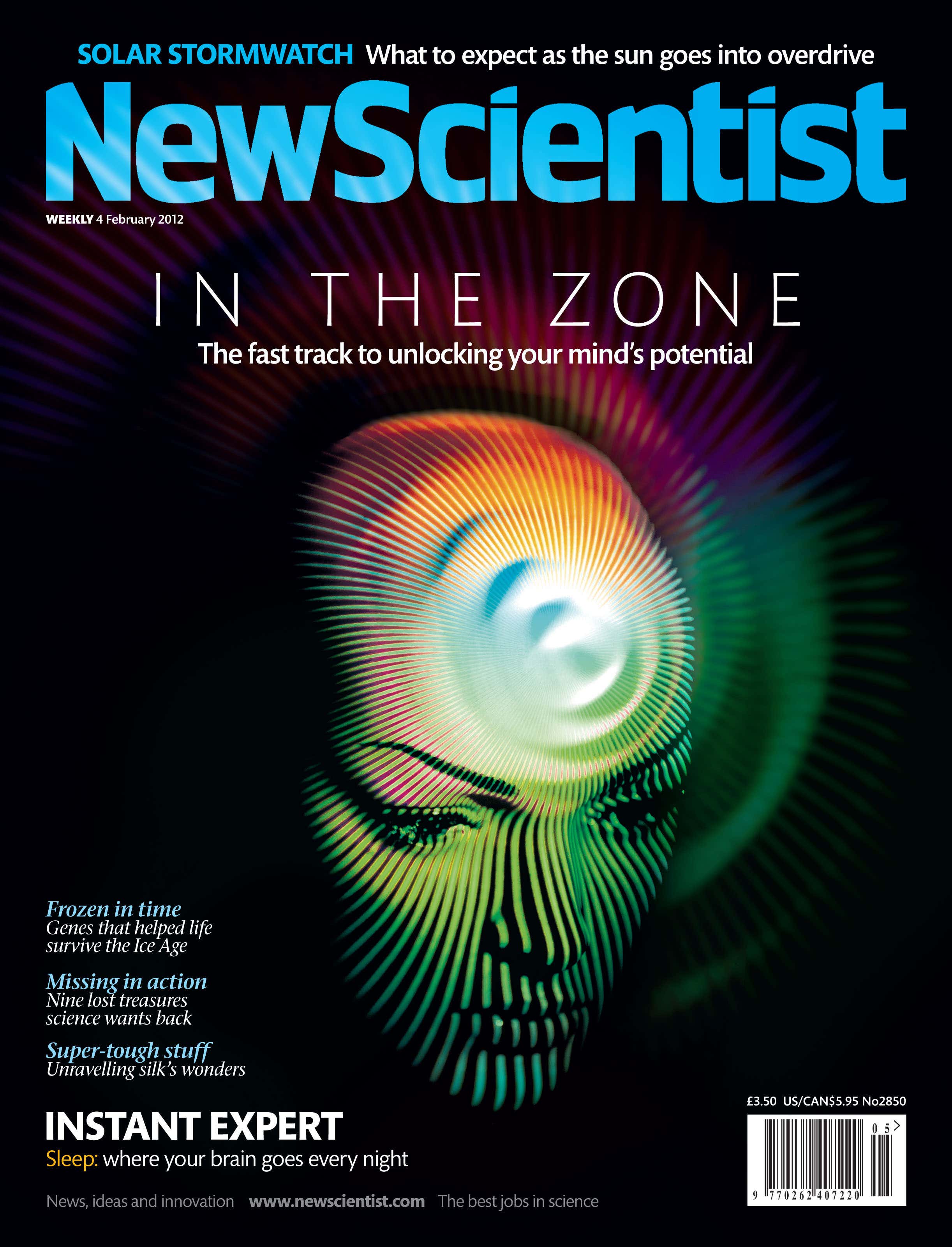
Issue no. 2850 published 4 February 2012

Sign up to our weekly newsletter

Receive a weekly dose of discovery in your inbox. We'll also keep you up to date with New Scientist events and special offers.

Sign up
Piano Exit Overlay Banner Mobile Piano Exit Overlay Banner Desktop