Subscribe now

Letters archive

Join the conversation in New Scientist's Letters section, where readers can share their thoughts and opinions on articles and see responses from experts and enthusiasts across a range of science topics. To submit a letter, please see our terms and email letters@newscientist.com


8 February 2012

Dead scientists

From Caroline Herzenberg

That another Iranian scientist has been assassinated is troubling (21 January, p 13) . As your article points out, attempts to derail a nation's nuclear programme by killing its scientists are a product of desperation and are counterproductive. Both nuclear energy generation and nuclear weapons are based on mature technologies. While the targeting of specialised …
8 February 2012

Chemical high

From Alex Saad

As a chemist I enjoyed Philip Ball's article "Forbidden reactions" ( 21 January, p 30 ), but what brought me most joy was the fact that it was a cover story on pure chemistry, a very rare event. Admittedly there is less public interest in chemistry compared with the other sciences because of its seeming …

8 February 2012

No K-T, no dinos?

From Gregory Paul, Author of The Princeton Field Guide to Dinosaurs

Your feature on the idea of progress in evolution included palaeontologist Simon Conway Morris's suggestion that ice ages would have killed off the dinosaurs and allowed mammals to take over the world if there had been no K-T extinction event (21 January, p 35) . This is physiologically and palaeoclimatologically naive. Dinosaurs were tachyenergetic, with …

8 February 2012

Keep the leap

From Martin Underhill

Felicitas Arias of the International Bureau of Weights and Measures suggests we stop adding leap seconds to coordinated universal time (UTC), which is based on atomic clocks, to compensate for its drift from astronomical time, mainly on the grounds that telecommunications systems do not work well with leap seconds (17 December 2011, p 27) . …

8 February 2012

Need to explore

From Jeff Dickens

In his letter, Brian Robinson says that, during a time of austerity, a hiatus in pursuit of the mysteries of the cosmos would not matter (28 January, p 33) . I struggle to find anything that matters more. On a practical note, I can think of no greater depressant to scientific education, and hence alleviation …

8 February 2012

Sceptical view

From Jeffrey Tapping

Why are scientists and teachers resistant to mentioning intelligent design and climate change denial in school science classes (21 January, p 4) ? They are wonderful examples to demonstrate the difference between pseudo-science and real science. Properly equipped teachers will not have to take sides, the students will work it out for themselves. Problem solved. …

8 February 2012

Beyond possible

From Don Carpenter

Jesse Prinz offers that "philosophy tells us what is possible, and science tells us what is true" (21 January, p 26) . This serves us well until we consider that all truth is bounded by its intrinsic context, and that the great expansions of science have come from those who look beyond the perceptual limitations …

8 February 2012

Toads for sale

From Matthew Vandenberg

I had no idea beetles could be such pests, as in the case of the bark beetle damaging North American forests (5 November 2011, p 38) . But I might have a solution. In Australia we adopted some amazingly beautiful creatures to get rid of pests – in particular the cane beetle. They're called cane …

8 February 2012

Kindle slip

From Pam Lunn

I have another example of game transfer phenomena, in which facets of video game play spill over into real life (24/31 December 2011, p 76) . I've been using a Kindle to read e-books for about a year now. The other day, while reading a paperback for a change, I pressed the side of the …

8 February 2012

Here, watching us

From John Davenport

Both Sepehr Ehsani's letter (21 January, p 28) and the review of How to Build a Time Machine (10 December 2011, p 52) assume that travellers from the future will be visible to our senses or to our instruments. Is there any proof of this? Perhaps we are surrounded by trillions of gawpers. All the …

8 February 2012

Perpetual motion

From Bob Donaghy

There is an obvious problem with the suggestion that a non-stop high-speed train could be boarded from a tram moving alongside it ( 3 December 2011, p 27 ) – the long parallel tracks required. A simpler plan might be for the passengers leaving the train to move to the last car, which would break …

8 February 2012

Hawking philosophy

From Gary Kitchen

Further to Michael Dowling's letter calling for the creation problem in cosmological theory to be left to philosophers rather than physicists like Stephen Hawking (28 January, p 32) . Hawking has already branched out into philosophy by espousing a theory called model-dependent realism, which holds there may be different, equally valid interpretations of reality. In …

8 February 2012

Lost and found

From Thoby Kennet

Whenever I can't find an everyday object – keys, paperback, spectacles – I create a vertical moving band using the side of my hand to scan my field of view. This causes my eyes to jump from object to object, which helps me find my quarry more quickly. Your story "Slow down your search to …

8 February 2012

For the record

• Saul (not Sam) Winstein was the champion of unconventional carbocation chemistry (21 January, p 34) . • In the CareersGuide 2012 sent to subscribers in the UK and US ( 14 January and 24/31 December 2011 ), we should have said the right to pursue happiness is in the US constitution. • In the …

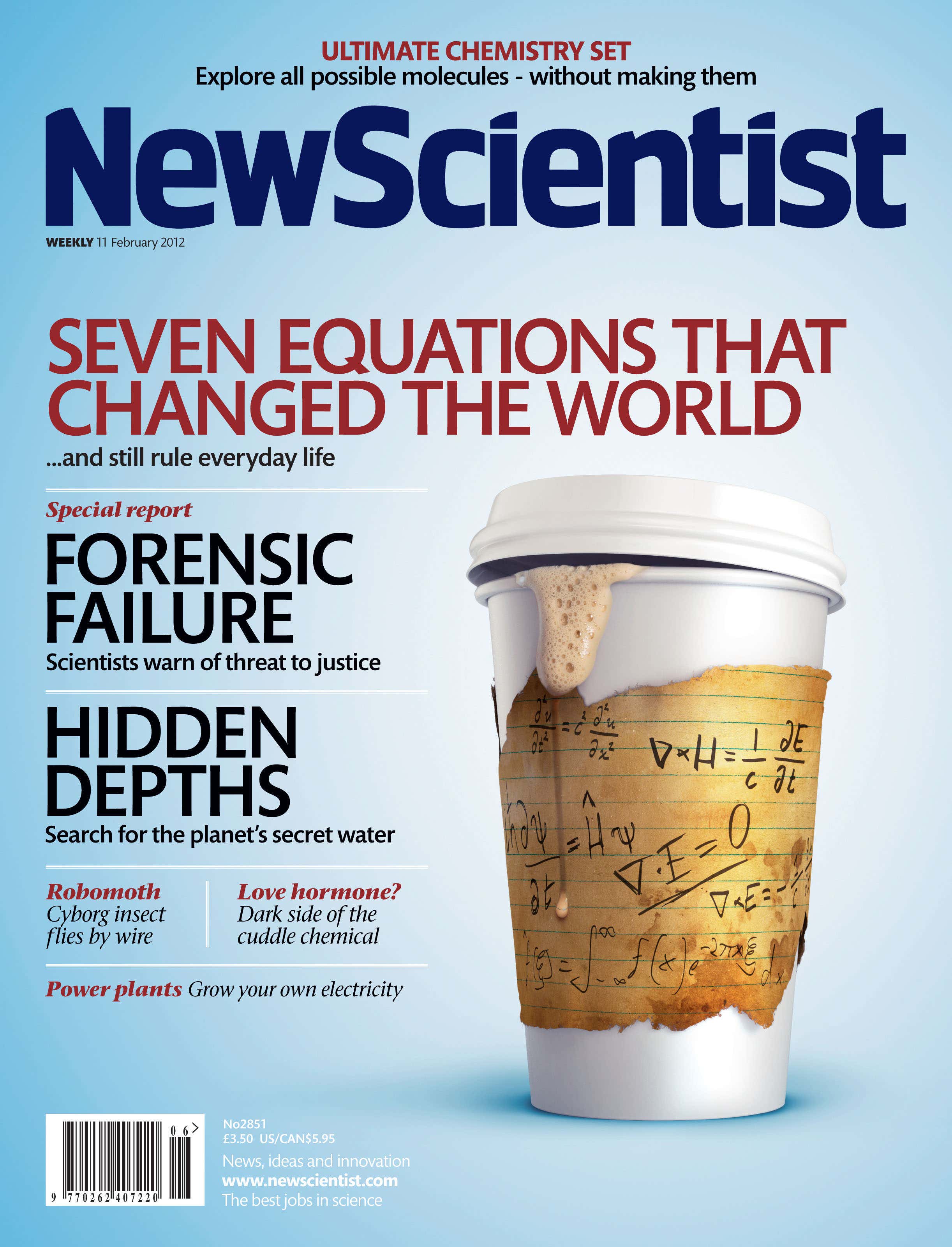
Issue no. 2851 published 11 February 2012

Sign up to our weekly newsletter

Receive a weekly dose of discovery in your inbox. We'll also keep you up to date with New Scientist events and special offers.

Sign up
Piano Exit Overlay Banner Mobile Piano Exit Overlay Banner Desktop