Subscribe now

Letters archive

Join the conversation in New Scientist's Letters section, where readers can share their thoughts and opinions on articles and see responses from experts and enthusiasts across a range of science topics. To submit a letter, please see our terms and email letters@newscientist.com


18 April 2012

Decline and fall

From Stephen Wilson

Like many readers, I'm sure, I read the article on the decline of phytoplankton and the cost of carbon fixes with a sense of dread (7 April, p 42) . It reminded me of historian Paul Kennedy's theory of imperial overstretch. In his 1987 book The Rise and Fall of the Great Powers , this …
18 April 2012

Salt! salt!

From Peter Urben

Reviewing the book Taste What You're Missing , Catherine de Lange raises the question of why we do not crave salt as we do the equally essential water (24 March, p 54) . But I do crave it, in exactly the same way; in fact, my cravings make no distinction. When I go for a …

18 April 2012

If we're so smart…

From Martin van Raay

"Why are humans the smartest animals on Earth?" you ask (24 March, p 3) . Suppose any animal, in less than 2 million years, changed its environment so thoroughly that not only did many other species die out, but the existence of the animal itself was endangered. Would we call that animal "the smartest on …

18 April 2012

Wilful genes

From Rhiannon Miller

Your special report on God mentioned the human tendency to describe events in terms of agents, even when we know this is not truly the case (17 March, p 38) . I have often thought that this tendency causes problems for people struggling to understand how evolution works. We talk of antelopes evolving longer legs …

18 April 2012

Multiple morals

From Richard Harris

Robert Kurzban suggests we have at least two parallel systems for deciding right and wrong: one based on kin selection and one prohibiting specific actions (18 February, p 10) . These moral systems often suggest outcomes that are in conflict. I don't doubt that we have a utilitarian mode, but we are also concerned with …

18 April 2012

No evidence

From Graham Cox

Charles Darwin suggested humans first stood up to free their hands to use tools. Kate Douglas says we know this "cannot be right since the oldest tools are a mere 2.6 million years old" whereas bipedalism arose 4.2 million years ago (24 March, p 36) . Who can be certain there are no older relevant …

18 April 2012

How did we leap?

From Paul Devitt

Your report on the biggest questions in human evolution ( 24 March, p 34 ) does not adequately address how the "great leap forward" occurred about 50,000 years ago. From that point on, humans were radically different from their ancestors and other creatures. We assume this had physical or biological causes, such as climate change …

18 April 2012

Bodies of the future

From Geoffrey Shephard

Stem-cell research promises great changes to our lives by providing spare parts for our bodies, so extending human lifespan to centuries. Surely their effect on the human body 100,000 years hence will be just as profound as those arising from genetic engineering, climate change and so on, suggested in your Deep Future special (3 March, …

18 April 2012

Virtually first

From Ephraim Nissan, Goldsmiths, University of London

You reported on animals made to think inside a virtual world (17 March, p 6) . Virtual reality for animals is a concept I proposed nearly 20 years ago in a paper entitled "Cyberspace for animal husbandry" ( Computers and Electronics in Agriculture , vol 8, p 251 ). I suspect this is widespread in …

18 April 2012

Ineffable deities

From John C. Roy

Victor Stenger betrayed a basic mistake in supposing that the methods of natural science could possibly test the existence of a supernatural being (17 March, p 46) . There is no test: quite apart from the hubris, it is impossible. To put it very crudely, if God exists, he/she/it/they will not be that easily fooled. …

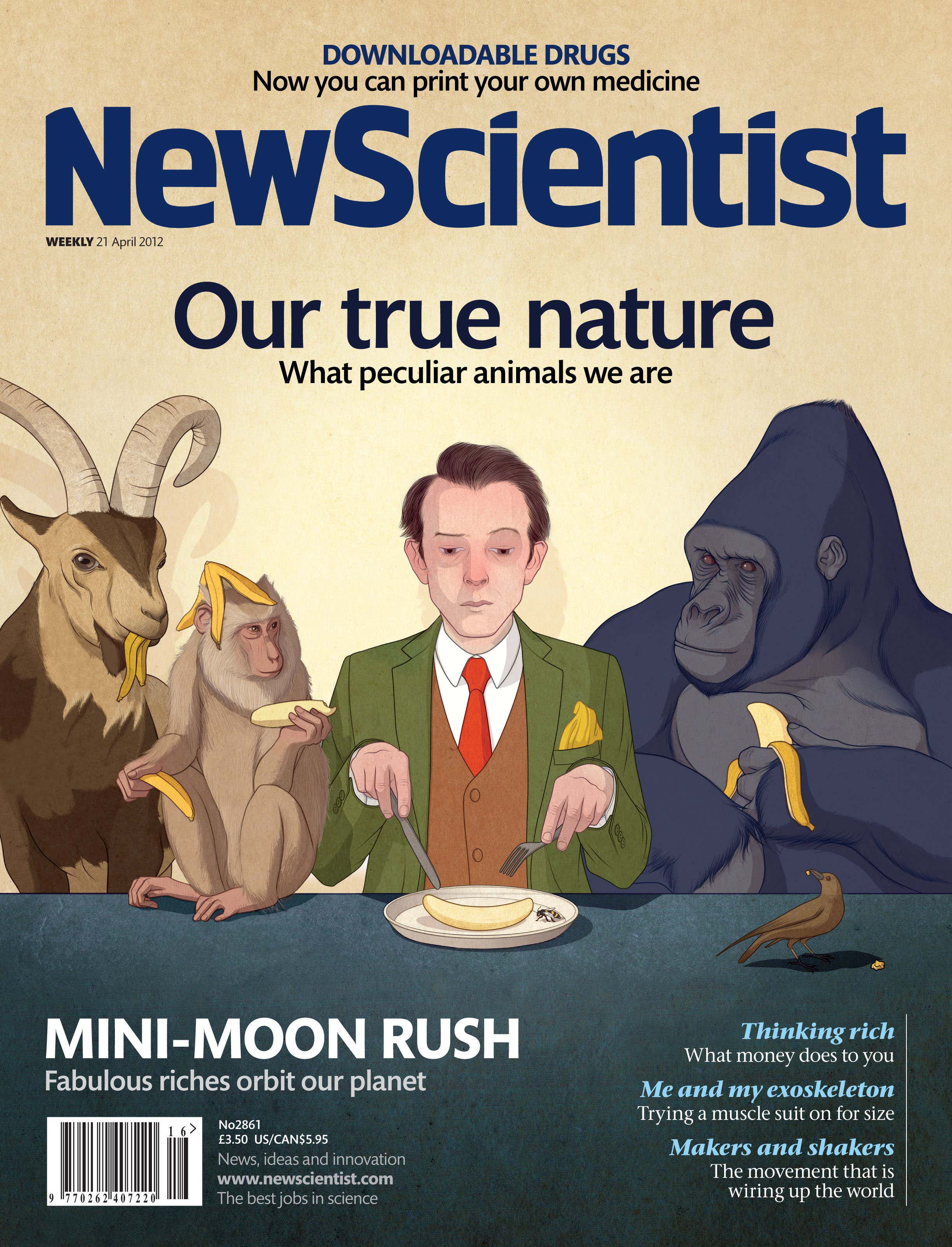
Issue no. 2861 published 21 April 2012

Sign up to our weekly newsletter

Receive a weekly dose of discovery in your inbox. We'll also keep you up to date with New Scientist events and special offers.

Sign up
Piano Exit Overlay Banner Mobile Piano Exit Overlay Banner Desktop