Subscribe now

Letters archive

Join the conversation in New Scientist's Letters section, where readers can share their thoughts and opinions on articles and see responses from experts and enthusiasts across a range of science topics. To submit a letter, please see our terms and email letters@newscientist.com


16 May 2012

If fish could fly

From Ian Flett

The top-down theory of the evolution of flight due to the impetus of gravity, outlined by Alan Feduccia (28 April, p 28) , is supported by the fact that true flight has never evolved in animals living in water, where the surface is flat. Flying fish do not actually fly, but rather use the aerodynamic …
16 May 2012

Selfish gene?

From Richard Mellish

The theories to explain the negative correlation between wealth and empathy that you described are plausible (21 April, p 52) , but I would like to offer another possible causal connection. People who care less about others are more likely to see life as a rat race, and more likely to push their way ahead. …

16 May 2012

Space mining

From Brian Robinson

The issue of who can own asteroids and their associated mining rights needs settling (21 April, p 48) . Returns for mining companies need to be sufficient, but the ordinary people must not be forgotten. I suggest asteroid mining rights be held in trust by the United Nations for the world population, with licences granted …

16 May 2012

Silt crucial

From Brian King

Possibly the main impact of China's plans to dam the Brahmaputra river (28 April, p 8) will be the restriction on the supply of sediment to the Ganges delta. This will greatly increase the rate of erosion and loss of land in the delta, mainly in Bangladesh. The delta is sinking due to the weight …

16 May 2012

Look at me

From Flora Nuttgens

Psychologist Jeffrey Arnett's observation that young people are volunteering in greater numbers does not necessarily contradict the theory that today's youth are more narcissistic than previous generations (28 April, p 44) . In a culture of social networking, drumming up charity donations for running a marathon via email or Facebook is an effective way to …

16 May 2012

The human animal

From Darcia Narvaez

In trying to pin down common characteristics that set us apart from other animals ( 21 April, p 38 ), you forgot perhaps the most distinguishing: humans can thwart their basic mammalian needs because of cultural ideology. Some can deny their babies breastfeeding, touch, responsiveness and even play, creating a different nature from their evolutionary …

16 May 2012

Social media

From John Hudson

Jim Giles describes the finding that conscientious people use more colons in their tweets as an "odd surprise" (28 April, p 40) . But is it? Colons are refined and nuanced appendages to the ordinary, run-of-the-mill lexicon of grammar; exactly the sort of thing that conscientious people, well attuned to the niceties of protocol and …

16 May 2012

Limited diet

From Emil Kucera

Helen Knight writes that "various studies have shown that people with restricted choice – or none at all – often feel happier with a given outcome than those with more freedom" (14 April, p 36) . It seems that authors knew it long ago. In Kenneth Roberts's book Northwest Passage , published in 1937, we …

16 May 2012

Earlier and earlier

From Bob Gray

Further to Stuart Goldman's letter on driverless cars (28 April, p 31) . I don't suppose German author Erich Kästner was the first, but he described them in his 1931 story The 35th of May . Also mentioned were mobile phones and moving walkways, along with portals to alternative realities at the back of a …

16 May 2012

Sleeper cells

From Lee Seldon

I read with interest your article on so-called sleeper cells – bacteria that become dormant to survive antibiotics, reactivating when the threat has passed (31 March, p 40) . From experience, I am sure Burkholderia pseudomallei (previously called Pseudomonas pseudomallei ), which causes melioidosis, should be on the list of such organisms. I got this …

16 May 2012

Faith and reason

From Bill Straub

Your story on how thinking analytically can dim religious belief (5 May, p 14) fitted perfectly with members of the church I used to belong to. When pressed to really think about what they professed to believe in, most people preferred not to do so. The few who opted to analyse their beliefs, like me, …

16 May 2012

Quick slime

From Marshall E. Deutsch

When I read about the experiment in which slime mould spread patterns were shown to mimic road networks in the US ( 24 March, p 23 ), I thought it must have been carried out on maps. Then I realised that many US roads have yellow lines down the middle and that I had been …

16 May 2012

Dark difficulty

From Steve Wilson

It was intriguing to read that experiments suggest dark matter may not be present in our part of the galaxy (28 April, p 6) , whereas the majority opinion is that it should be. More intriguing for those of us with a sceptical nature was the statement by Rory Smith of the University of ConcepciÓn …

16 May 2012

Growing resistance

From David Payne

Alasdair Cook's letter (28 April, p 30) , quoting a 1948 report from the Veterinary Record on a diminution in the efficacy of penicillin, rang a very loud bell. In 1823, doctor John Elliotson wrote in The London Medical Gazette : "When we first had sulphate of quinine I was generally able to cure the …

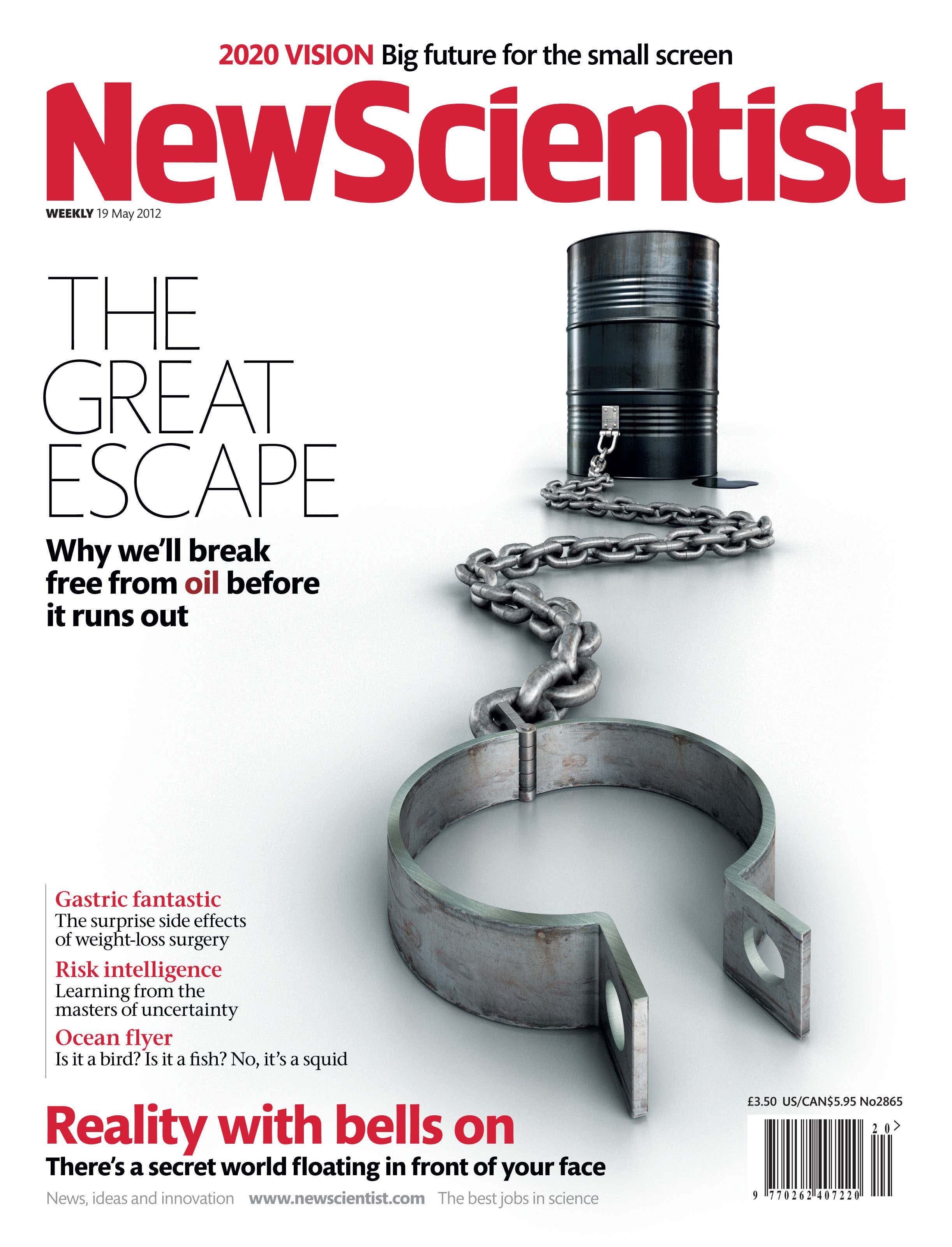
Issue no. 2865 published 19 May 2012

Sign up to our weekly newsletter

Receive a weekly dose of discovery in your inbox. We'll also keep you up to date with New Scientist events and special offers.

Sign up
Piano Exit Overlay Banner Mobile Piano Exit Overlay Banner Desktop