Subscribe now

Letters archive

Join the conversation in New Scientist's Letters section, where readers can share their thoughts and opinions on articles and see responses from experts and enthusiasts across a range of science topics. To submit a letter, please see our terms and email letters@newscientist.com


18 July 2012

Higgs reaction

From Alan Barr, University of Oxford Department of Physics

Only time will tell whether or not the particle identified in experiments at CERN is the Higgs boson (14 July, p 6) – or just one of many, since theory suggests there may be more than one. For the moment, we have reached what seems to be the summit of achievement. Yet we still have …
18 July 2012

Irrational fear

From Abimanyu Nagarajan

Fear not for rationalist Sanal Edamaruku, facing arrest for debunking claims of a miracle at a Catholic church in Mumbai (30 June, p 27) . He is a great guy who works tirelessly to stamp out ignorance, and nothing has happened to him yet. I still recall one instance a couple of years back involving …

18 July 2012

ET knows best

From Anthony Wheeler

What is it that the Search for Extraterrestrial Intelligence (SETI) expects to gain from contact with aliens (30 June, p 28) ? I suspect that like naughty children we are waiting for a superior being – maybe a mother figure – to tell us what to do. We know what we are going to be …

18 July 2012

Life's origins

From Stuart Henderson

In your look at how life on Earth might have emerged, Nick Lane notes that complex cells evolved just once (23 June, p 32) . All eukaryotes alive today descended from a common ancestor, but what if other lineages came about only to go extinct? When a cell absorbs a different cell type in the …

18 July 2012

It's complex

From John Campion

As observation and much psychological research show, contrary to Philip Penton's letter (7 July, p 31) , not everyone cheats. The strength of people's moral code varies hugely. It is this that is interesting and needs understanding. And, when I consider the complex and changing nature of my political beliefs and the various circumstances that …

18 July 2012

Value for money

From Niall Litchfield

In your editorial (7 July, p 5) you assume that the $1 million it would take to keep an asteroid-spotting telescope going for five more years is good value. Almost certainly, the expected number of lives saved by the $1 million spent on planetary defence would be dwarfed by the same amount spent on, for …

18 July 2012

This won't hurt

From David Evans

Your story on an insulin pill (23 June, p 20) states that it could spell the end for "painful injections". In Australia, diabetes educators have for years taught good injecting techniques. It takes a truly clumsy person to make an injection hurt. Far too many parents teach their children terror of needles, syringes and injectables.

18 July 2012

Ball breaker

From Richard Glover

In his letter, Richard Wilson suggests a more humane way of controlling the testosterone-fuelled excesses of investment bankers than by castration (30 June, p 30) . However, when you consider the damage done to economies worldwide by their greed and recklessness, and the resulting misery inflicted, the idea of surgery does have its appeal.

18 July 2012

Trust is gone

From David Flint

John Sulston writes in his letter "the Rio declaration appears to agree so little", later stating "we must trust to deliver our future" (7 July, p 30) . For 20 years we have watched world leaders duck, dive, obfuscate and lie whilst governments and corporations trash the planet in the name of profit and prosperity. …

18 July 2012

Mind over body

From Dewi Jones

Controlling robots with our minds through an fMRI scanner may offer hope for disabled people and those with locked-in syndrome (7 July, p 19) . But wouldn't it be better to link two humans in that way – for one to embody another? In places where skilled surgeons are not to be had, surgical robots …

18 July 2012

Tinted view

From Marshall E. Deutsch

Jeff Hecht discusses the possible benefit of being exposed to less blue light at night and more by day, and suggests varying the light sources to which we are exposed (30 June, p 42) . This may be an ideal solution, but since light receptors are in the eyes, a far less expensive and more …

18 July 2012

Docs take note

From John Watson

Your special report on the treatment of lung cancer (30 June, p 6) is very illuminating. The UK's National Health Service will be neglecting its duty if it does not ensure that this is drawn to the attention of all its chest specialists, oncologists and GPs.

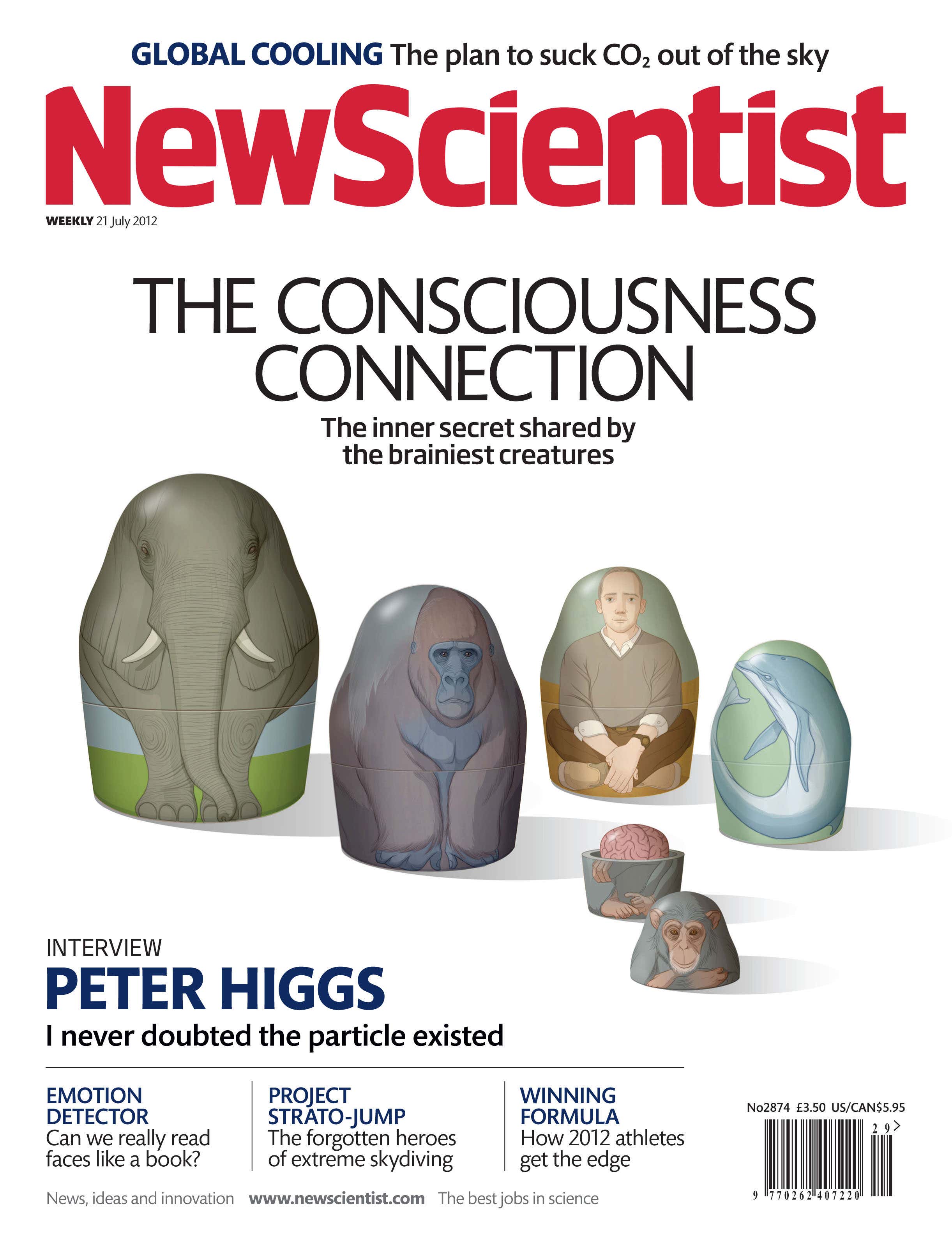
Issue no. 2874 published 21 July 2012

Sign up to our weekly newsletter

Receive a weekly dose of discovery in your inbox. We'll also keep you up to date with New Scientist events and special offers.

Sign up
Piano Exit Overlay Banner Mobile Piano Exit Overlay Banner Desktop